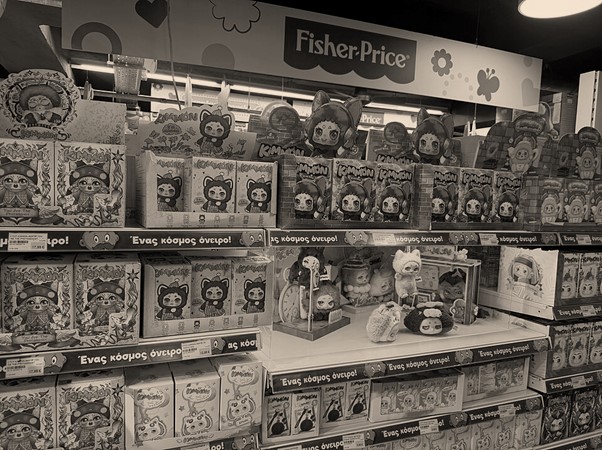
Whenever I visit my grandfather, I like to bring trinkets from my world to his. He is ninety-one years old, and while he does not understand the point of any of my gifts, he does appreciate them. I recently visited him again, and this time I gifted my grandfather a blind box. I handed it over to him, trying to find the right words to explain what my almost-a-century-old grandfather was holding in his hands. The only explanation I had was ‘It’s a blind box, gramps. It’s like… gambling, but for kids.’
Blind boxes have risen in popularity lately. This summer, for example, those creepy-smiley Labubus were everywhere. People would line up in front of stores. They even bought tickets to Dutch Comic Con, the most well-known Comic Con event in the Netherlands. Many people gather there to dress up, meet their favourite actors and artists, join costume contests and more, but these people bought tickets just for the Labubus. Situations like these almost transport you back to Black Friday in 2005, where you still had to queue in real life instead of behind your screen. The popularity of Labubus is not the only reason why blind boxes are so popular; there are many different types from many different tv shows, movies, videogames and other media. You name it, and there is probably a blind box for it. They could be compared with Funko pops, which are square-headed plastic pops with soulless eyes, dressed up as your favourite characters, ranging from your favourite pop singer to your least favourite Marvel character. While I do ridicule Funkos, I must admit that I myself still have a few laying around in my room. Funko, however, is not doing well, as they appear to be in major debt as of last year (Gach, 2025). So how come blind boxes, which have been around longer than Funkos, are even more popular than before?
At the moment, there are whole stores, or sections of them, dedicated to blind boxes. For example, in the main shopping street in Amsterdam, there are two Minisos alone. Miniso is a store that carries products ranging from toys to household items, most of them themed with pop culture concepts. From a Barbie hairbrush to Winnie the Pooh cutlery, Miniso has it all. They also have whole sections where they only sell, you guessed it, blind boxes. Another store that mostly sells blind boxes is Pop Mart. Many other smaller stores sell blind boxes as well.
The thrill of a blind box is that you do not know which character you have in your hands. Usually there is also a special, secret, rare figure. The appearance, or ‘drop rate’, of these figures are lower, creating the illusion that they are worth more, with some of them being resold for hundreds of euros. And when you stand in the store holding that box, there is a slight chance that this super rare figure is in your hands. Your brain tricks you into thinking that this could be the one. Having the chance of receiving that item is where the excitement comes from (Scott, 2026). As Dr. Hronis states, ‘the brain finds it “exciting” to wait in suspense and have a reward revealed’ (2026).
In the Netherlands, blind boxes are, legally speaking, not gambling. According to JouwGGD, for a game to be considered gambling, it has to be a game of chance where you play with money, or something that is worth money, so that you can either win or, more importantly, lose money. With blind boxes, this is not the case, because you always get something out of the box. You never really ‘lose’, even when you do not get the figure you want. The system, however, works the same as gambling. It is still a game of chance; you do not know which figure is in the box. It could be the rare one, but it could also be one that you do not want. The dopamine that your brain creates when buying and opening a blind box is the same kind that you get when gambling with money (Hronis, 2026).
Blind boxes are not very expensive, usually ranging between fifteen to twenty euros. Most children receive that amount of pocket money every month, just enough to buy a blind box. Thus, it is an affordable entry to gambling, because that super rare secret figure may be inside! Even though these mystery boxes are, legally speaking, not gambling, it does promote gambling to children, because these blind boxes are accessible for children, and sometimes even directed at them. LEGO has been releasing blind bags for ages. They used to be made out of plastic, and I spent hours in toy stores feeling the bags until I was sure I got the one I wanted.
Then LEGO came out with little carton boxes, and, while probably better for the environment, buyers were now unable to feel which figure was inside. To not promote gambling to their audience, a large chunk of which consists of children, they added a little QR code on the bottom of these boxes. You can scan this, and it tells you which figure is inside. While it is better for children not to gamble, obviously, this also means that the most popular figures will be gone quickly. For example, LEGO recently released their Minifigures Series 29, which had a specific Minifigure that became so popular that it sold out everywhere. Most people were not able to get it in-store. Some of these figures will then be resold on eBay for a kidney and an arm. This practice is called ‘scalping’. Scalpers buy up all the stock, then resell it online for a much higher price. Blind boxes themselves are also not immune to this. The fact that some drop rates are lower increases the desire for them, thus, some people may be more willing to drop a few extra pennies for it. LEGO’s QR code system does not make it easier or harder for scalpers; it basically means that you are not buying the box ‘blind’, and many other figures and items are being sold that way. It will, however, never defeat the memories you have of touching the plastic baggies until you were a hundred percent sure you found the Lego Batman in a pink tutu. Scanning the box will never be as fun as trying to find that specific minifigure yourself.
The good thing about blind boxes, if there even is one, is the sense of community. My friend and I visited Pop Mart recently. They spent a long time holding these blind boxes, shaking and weighing them. Soon, another person showed up, and for the next ten minutes they chatted, shaking boxes and sharing which ones they did or did not want. After their purchase, they opened the boxes together. Disappointment struck when the other person got the only one they absolutely did not want, and my friend traded their figure with them. Everyone exited the store happily. Just like with trading Pokémon cards, it creates contact with other people who are interested in the same movies, games, and tv shows. In a mostly digitized world, these interactions are priceless. And perhaps a fifteen euro blind box is worth it if it carries a little memory like this.
I would like to end this article by stating that I, while ridiculing blind boxes, am not innocent to the craze. I shop at Miniso; I own a couple items that came out of blind boxes. Gambling creates dopamine, and I am not immune to it. It is important to lay out rules for yourself, if you ever plan on purchasing some, to prevent a blind box addiction. I have two rules for myself: I have to like all the possible figures inside, and I have to have a budget. It is tempting to buy another one after not getting the one you wanted. Gambling is heavily promoted in this capitalistic world– nowadays, you can even gamble with your ‘statiegeld’, the money you get from turning in your plastic bottles in the Netherlands. It is important to create and hold a boundary for yourself so you, too, will not succumb to capitalism and develop a gambling addiction. Even if it is not, legally, called gambling.
Leave a Reply