(Timestamp 00.00.00) We open in a hallway. On one side, a vase of fiery but aging roses stands at the end of an elegant wooden cabinet. A couple of petals have fallen on the floor. The opposite wall is covered in picture frames. The light pouring into the house from the opened doors to the back garden makes it so that we can only see the light reflected on their glass coverings. A calico cat on the kitchen table watches us looking. From around a corner, an elderly woman approaches, taking over the frame as she pulls us through a side door and into her cellar. A voice starts to speak:
“Ruysdaelstraat 71. Keesing. Publisher of, among other works, ‘Denksport’ and ‘Keesings Historisch Archief’. Jacob Keesing, his wife, Esperans, and his half-sisters, Suzanne and Marrianne, ended their lives in IJmuiden on the 15th of May, 1940, one day after the Netherlands capitulated to the German army. Many Jewish people had hoped to escape to England via the port of IJmuiden, but were unable to find a boat willing to take them there. The publishing house’s director, Isaac Keesing, was able to escape to America in 1942. He had entrusted the company to his accountant, Peter Driesveld. Driesveld was expected to work under the supervision of a German ‘verwalter’, a type of administrator that was instituted to supervise Jewish-run companies. A member of the NSB (the Dutch Nazi party) was appointed as the magazine’s new editor-in-chief. Driesveld continued to secretly pay his former Jewish employees. He moved into Isaac Keesing’s house where he helped Jewish people into hiding. The office was also used on occasion to harbour employees. A printer hid himself for nights on end on top of the elevator.”
When the woman has retrieved what she was looking for, and the cellar door falls shut behind her, she switches off the lights and the scene ends. A second later, we open on the next location, as, over the following four hours, we work our way through present-day Amsterdam and are told about its history during the Nazi occupation.
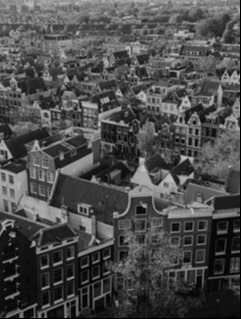
Occupied City (or ‘De Bezette Stad’ in Dutch) is a 2023 documentary film by British filmmaker Steve McQueen based on the book Atlas of an Occupied City: Amsterdam 1940–1945, which was written by his wife, author and historian Bianca Stigter, and which methodically exposes Amsterdam’s WWII history at both street and house level. Whereas most documentaries focussing on the Second World War and the Holocaust rely on archival footage for their visuals, McQueen has chosen to document Amsterdam in its present day form. Given that shooting started in 2020, the visual language of this documentary is therefore forced to confront both the political present as well as the past, with COVID, the anti-vaccine protests, the assasination of a famous Dutch crime-investigator and, finally, the Russian invasion of Ukraine in 2022, all intertwining with a history that is still being narrated and expanded. A calm monotonous voice carefully tells us about each location’s story, which follow each other up at a consistently high pace, only occasionally leaving breaks to record present-day events as they play themselves out in front of the camera.
Occupied City is certainly not McQueen’s most celebrated project. Criticised for its slow pace and disinterest in interpretation, most reviews make it difficult to get any impression of the film other than that it is tedious to get through. In an article in Vogue magazine, American film critic Owen Gleiberman interprets McQueen’s lingering camera shots as superficially encouraging viewers to reflect on how history might repeat itself in the very locations where it once played out. Gleiberman mourns the fact that the documentary doesn’t put more effort into humanising the lives it narrates, but instead relies on an ‘objective’ form of storytelling. Comparing it to the famous Holocaust documentary Shoah, he notes that the latter more effectively brings its subjects to life to create an immersive and, as he calls it, “mesmeric portrait of evil looming up from the past over the present.” The objective nature of Occupied City, he snarkily concludes, in combination with its four-hour runtime, makes it destined to be ignored by audiences and to be “tossed, like everything else, into a vast sea of content.”
However, it seems that Gleiberman’s interpretation of the role the past plays in this documentary misses the actual effect of its inclusion. To me, the way Occupied City deals with history differentiating it from other war documentaries like Shoah, is not only that it presents information about the war objectively and blandly, but that it does so by realistically depicting the way history continues to survive once the generations who were there to experience it have passed away. What remains is a historical database, an atlas, that efficiently summarises and sorts the lives of people into brief records, records that are meant to help us remember without taking up too much of our time, and which somehow are expected, in all their efficient blandness, to compete with the excitement and liveliness of the present day. What Occupied City does, quite effectively, is that it purposefully asks us to care within an underdramatised environment, and that it allows us to literally test our own ability not to be distracted from a tragic history in the face of a present that keeps racing on. The documentary, while it deals with history, is arguably much more a documentary about life and the experience of living in contemporary Amsterdam than it is specifically focused on Amsterdam from 1940–1945. This relationship to the past as something that exists in the present as a continuously more distant story also helps to explain one of the more controversial moments in the documentary. About 17 minutes in, the camera shifts to:
(Timestamp 00.17:10) An anti-vax demonstration. Museum square. A woman dressed in a woollen, strawberry-themed outfit is holding a heart-shaped cardboard sign. ‘Freedom for everybody, go vegan!’ it cheerfully exclaims. In the background, ominously floating above her head is a large, flashing screen projecting the words ‘Safety risk area’ and ‘You may be searched by the police’. Two officers are calmly talking to one another, both wearing facemasks, on a busy square full of bare-faced people. A middle-aged man wearing a green hat against the cold is holding up a sign towards the camera reading ‘Freedom over everything’. A middle-aged woman smiles as she looks around holding a sign rhetorically asking people ‘Can we talk about it?’. Cut to two early-20th-century fighter planes passing over the square, each carrying a white banner in their wake. ‘Emotionally and financially held captive,’ the first one starts; ‘we peacefully gather to drink coffee,’ the second finishes. The planes are met with loud, happy cheers and whistles from the ground where people have started to dance with each other in a circle. There is no voiceover.
(Timestamp 00.18.10) A police officer calls out to the protestors through a megaphone. ‘The area will now be evacuated. If you do not leave voluntarily, we may resort to using violence,’ he warns. The crowd continues to dance. Cut to the conservatory building as the narrator begins to speak.
(Timestamp 00:21:30) The narrator stops speaking. A loud explosion can be heard as the camera lingers on a deserted stage and rows of empty theatre seats inside the conservatory building. Outside we see armed officers, some on horseback, moving in and taking control of the area. A frightened crowd runs away over the green.
“Is he drawing some sort of parallel between the pandemic protocols and what the Nazis did?” Gleiberman wonders. “That’s certainly what he seems to be doing. Or is he making the comparison only to dismiss it? The fact that we even have to ask is, frankly, a little bizarre.” (source) McQueen’s response to this accusation is both brief and decisive: “People can link Swiss cheese to a computer. They could do whatever they want. But the fact of the matter, what’s interesting about it, is that people are always trying to make sense out of things. But what we found out through our research of the Second World War is that the more you know, the less you know. It’s just more complex than that, unfortunately. […] If anything, what that scene demonstrates is who we are now and where we are now.” (Abe Beame). And given the context of the COVID measures Amsterdam was going through during the time of recording, it’s not necessarily the documentary that draws this parallel, but rather the world it is aiming to depict. Throughout its runtime there are multiple occasions where we hear politicians, radio presenters and journalists make comparisons between COVID measures and policies during the Second World War, most notably, the dusk-to-dawn curfew measures being discussed in the context of returning for the first time since the end of the war, and Prime Minister Mark Rutte prefacing his announcement for a second lockdown by saying COVID is the most significant communal experience since 1945. Even the aforementioned protestors with their signs celebrating peace and freedom tie themselves into this narrative. This does not have to mean that the documentary offers the status of WW2 resistance to anti-vax protestors. If anything, the documentary has captured the strange and often morally confusing way in which the Netherland’s war history was intentionally brought back into the way people made sense of their lives during COVID. There was no return of violent suppression and murder, but shallow, aesthetic connections: I am not allowed to leave my house, people back then were not allowed to leave their house. The connection is that something that existed back then, still exists now, only the context is completely different—almost like the addresses we have been visiting, which still exist, but with new residents and stories tied to them as well. In a documentary that is focussed solely on documenting the past, this might be perceived as offensive and misplaced; in a documentary about the present dealing with the past, it would be short-sighted not to include it.
(Timestamp 03:46:28) A tram is driving down its tracks crossing through the city past many of the locations we have previously visited. The tram moves forward. The camera looks towards the front of the tram, the camera looks towards the back, the camera looks toward the side, but still, the tram moves forward.


Leave a Reply