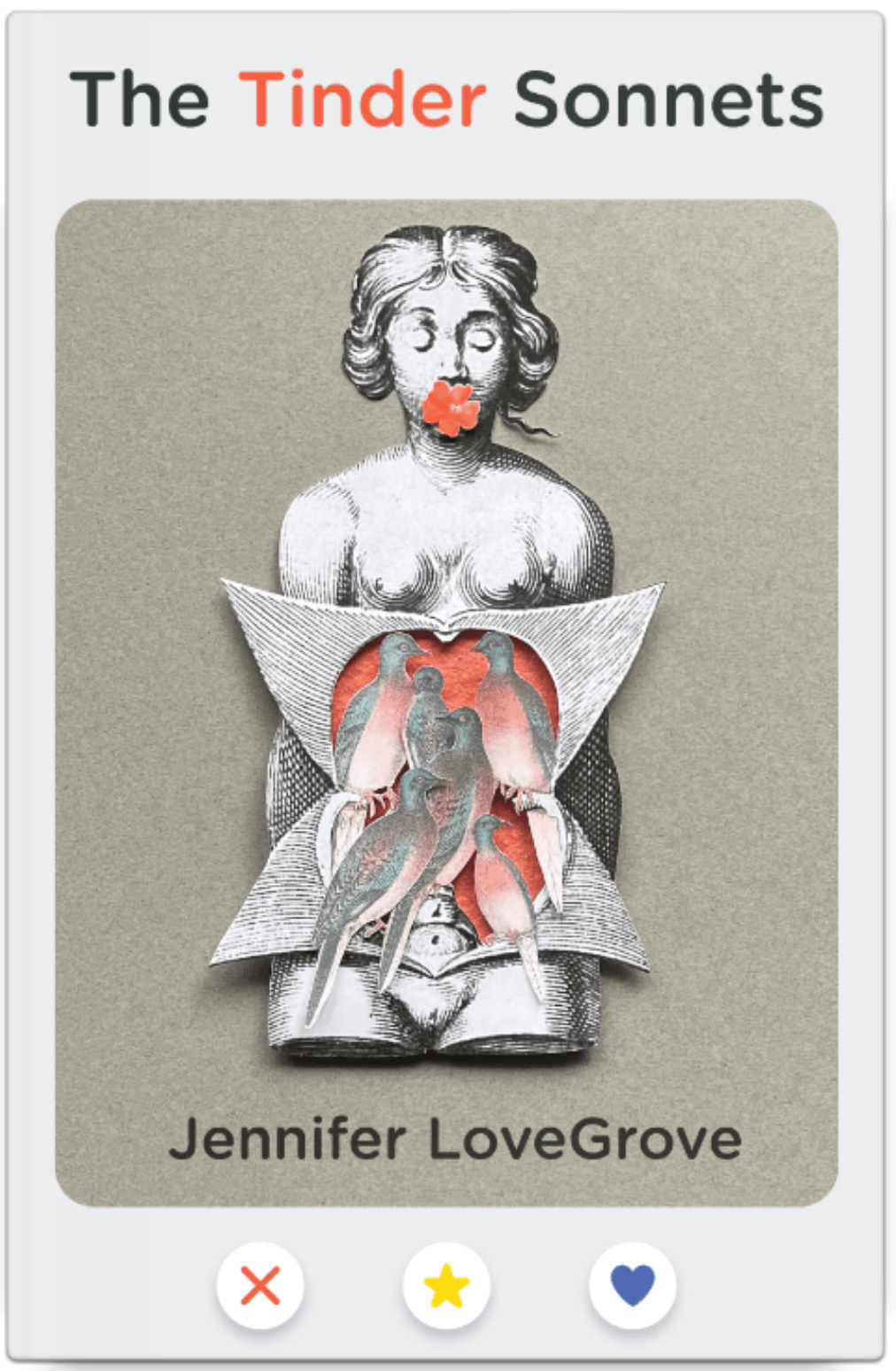
Dating apps promise abundance: endless profiles and endless chances to begin again. Yet beneath their image of choice and connection lies a more unsettling reality, particularly for women, whose pursuit of intimacy is often entangled with misogyny. Jennifer LoveGrove’s The Tinder Sonnets is a poetry collection that captures this tension. It explores the reality of dating as a middle-aged woman in a social media-driven world. Reworking the traditionally romantic sonnet for the era of swiping, ghosting, and disappearing messages, LoveGrove transforms the rituals of contemporary dating into a piercing meditation on desire, intimacy, misogyny, alienation, and violence.
When we were approached to review this collection, I was instantly intrigued by the idea of poetry that explores dating apps. After making my own debut on dating apps last year, I was confronted with the misogyny that runs rampant in dating culture. Given how dehumanizing modern dating can be, I was curious to see what LoveGrove, whose work I had never read before, had to say about the matter.
While The Tinder Sonnets digs into the frustrations and absurdities of dating apps, it ultimately asks what it means to seek intimacy as a woman in a culture where vulnerability is frequently met with callousness. The collection follows a speaker as she navigates a series of encounters, but the poems resist a straightforward narrative. Men often appear only in fragments: as a text message, a brief moment of intimacy, a disappearance. Connections emerge and dissolve with little explanation, reflecting the disposability encouraged in dating culture. The poems formally mirror the instability and fragmentation they describe. Repetition, lists, deleted messages, and fragmented syntax evoke a sense of emotional turmoil, unsettling yet striking as it takes place within the sonnet, a poetic form historically associated with romantic devotion. Rather than depicting idealized love, however, The Tinder Sonnets offers something far more raw and melancholy.
The collection foregrounds the often-normalized fear and harm that women navigate in their pursuit of love, alongside the tension between desire and danger that permeates those experiences. The speaker longs for connection, tenderness, and pleasure. Yet for women, vulnerability remains inseparable from risk. In depicting a series of unfortunate encounters, LoveGrove illuminates patterns of behavior and power that emerge in contemporary heterosexual relationships. Even as the speaker largely narrates her personal experiences, she situates them in the collective experience of women, who “are still killed by accident, by design” (71). One of the bleakest moments occurs when a neighbor’s threat against the speaker is reported to the police, who “shrug, sneer,” and ask, “What do you want us to do about it?” (65). The speaker, thereby, holds not only romantic partners accountable but also institutions. Her critique thus extends beyond discussions of dating culture to expose and highlight the structures and systems that feed women’s suffering.
The poems’ imagery deepens her critique. The speaker describes love using economic language: “Warlords, landlords, slumlords. Our wombs, now theirs. / Flex and girth, curtsy and curse. All love is / blockade, more debt than wealth. Tax hike desire. / Bruises depreciate, emotional / inflation, economy of regret. / Be a good fishwife and straighten out the / nets. Brighten up your skirts, it’s time to get / snagged all over again. Scars and pockmarks / shaped like technicalities” (55). She shows how dating culture mirrors consumer culture; women become disposable commodities who are exploited. She also draws extensively on nature, which counters the dehumanizing logic of dating culture. Recurring images of minerals, trees, rivers, and firewood provide a counterpoint to the artificial world of profiles and algorithms. These natural images are vehicles for expressing women’s pain, desire, resilience, and transformation. They lend texture and beauty to an otherwise ugly issue.
The speaker offers more than an account of the harsh realities of dating. Even as the collection depicts gendered harm, it stresses that: “Survival is important to women, / but that alone is not enough. We can / do much more than not die” (111). LoveGrove refuses to settle for narratives of endurance alone and insists on the possibility of pleasure, growth, and connection. In the final poem, LoveGrove tentatively offers a glimpse of hope, narrating a relationship marked not by certainty but by gentleness: “Trees echo / shade each fall, and for a few weeks nothing / splinters my attention or desire for / heat. We pitch into sheets, despite our pasts, / we are gentle, cautious — at least with each / other. We take up swimming, shed skin, hair, / grow new scales, fins, in secret. Stacked to lean / away, there is enough firewood to burn / shards of shadow selves. We fall ashen, singed, / but intact, and promise to burn in kind” (119). After a collection dominated by ghosting, manipulation, and violence, the final poem imagines an alternative model of intimacy, suggesting that love need not be structured by the same disempowerment that characterizes much of the speaker’s dating experiences.
The Tinder Sonnets succeeds because it refuses easy distinctions between the personal and the political in its account of love. Dating apps provide the collection’s framework, but they ultimately become a lens through which LoveGrove asks larger questions about gender, power, and the patriarchal conditions under which women seek love. The beauty and brutality of love coexist in these poems, creating an unsettling collection that strips love of its illusions, yet in doing so allows us to envision a more ethical form of love. As such, The Tinder Sonnets offers a timely and necessary reflection on the gendered realities of contemporary dating. The collection cannot resolve the injustices it confronts, but it gives language to experiences most often endured in silence, offering the comfort of recognition.
Thank you to Jennifer LoveGrove and Book*hug Press for a digital copy in exchange for an honest review.
Written by Emel Peksöz


Leave a Reply