“I find writing gets harder as time goes on. I’m speaking of the working process, which demands a certain amount of energy and courage (though I dislike using the word), and a certain amount of recklessness.”
— James Baldwin
Writing comprises challenges that demand perseverance. Ordinarily, I find its difficulties manageable, but recently, I have been struggling to write more than one page. It felt as if I was pouring from an empty cup. I did not know where to begin or continue, as though I had never written before in my life. Whatever I did churn out was insipid. Even on days I had flashes of inspiration that felt worth pursuing, the page had become an abyss I was unable to write myself out of. Conversations with fellow writers made me realize that, while its causes and effects differ from person to person, writer’s block is a common condition. I wondered why writers struggle to write even when they have passion and experience. Wherein lies the writer’s struggle?
Writers, perhaps on account of their predisposition to tell stories and sensationalize the mundane, tend to mystify writer’s block. The writer’s creativity is misunderstood as finite, and its absence as an effect of unaccountable forces. I myself made this mistake until the prolonged spell of writer’s block pushed me to disrupt my complacency and find a solution. Feeling unable to write, when writing has always been my lifeline, left a desolate absence. I longed to return to doing what I love most. Understanding the science of writer’s block enabled me to confront the source of my struggles and get back to writing. Perhaps it can do the same for those of you who are writers. By delineating what writer’s block entails according to scientific research, I hope to demystify the notion and provide a framework that helps identify and thus address the causes of your struggles.
I. Defining Writer’s Block
The term writer’s block was coined in 1947 by the psychoanalyst Edmund Bergler, who published the paper “DOES “WRITER’S BLOCK” EXIST?” three years later. Since then, writer’s block has become a widely known phenomenon, and of course, it is the name of our beloved magazine. Bergler defines writer’s block as the “neurotic inhibition of productivity in creative writers,” which reflects the psychoanalytic framework of its time. Scholars have since expanded the definition beyond pathology. For Sarah J. Ahmed and C. Dominik Güss, writer’s block is “a period during which a competent writer cannot produce new material.” Similarly, Mike Rose identifies writer’s block as “an inability to begin or continue writing for reasons other than a lack of basic skill or commitment.” Definitions vary by thinker, but a common thread tends to emerge: writing is meant to happen, yet it doesn’t—not due to insufficient skill or desire, but something less easily defined.
Writing itself is not limited to a singular action. As Noor Hanim Rahmat outlines, writing is a process that consists of several stages: prewriting, drafting, revising, editing, and publishing. Ahmed and Güss expand on these traditional stages with cognitive processes, explaining that writers oscillate between divergent and convergent thinking. Whereas divergent thinking generates ideas, convergent thinking evaluates and refines them. The writing process is hindered when these modes of thinking are used at an incorrect stage, such as generating ideas while having to edit. When you are struggling with writing, consider which stage you are at and how this requires you to think and act. However, this alone does not explain the primary causes of writer’s block.
II. Causes of Writer’s Block
While misalignment can hinder writing, research shows that writer’s block arises primarily from physiological, motivational, cognitive, and behavioral factors. In a study using mixed-method survey data from a mix of 146 professional and semiprofessional writers, Ahmed and Güss investigate what causes writer’s block. This study is limited by its correlational design, reliance on self-reported data, and sample size, but I find its categories useful. Ahmed and Güss report that the most common causes of writer’s block are physiological (42%), which encompasses stress, anxiety, illness, and emotional extremes; motivational (29%), which involves fear of evaluation, writing anxiety, and loss of intrinsic motivation; cognitive (13%), which contains perfectionism, overplanning, and rigid thinking; and behavioral (11%), which covers procrastination, irregular writing habits, and busyness. Furthermore, Ahmed and Güss identify articulation (36%), the expression of ideas into words, as the stage where writer’s block occurs the most, followed by the evaluation of ideas (18%), idea generation (15%), and planning (4%). These findings suggest that writer’s block is primarily emotional and arises during the articulation of ideas. In another study using mixed-method survey data from 29 academics, Rahmat investigates how academic writer’s block is engendered. Its limitations are similar to Ahmed’s and Güss’, with the key difference being that Rahmat focuses on academic rather than creative writing. Rahmat describes a cycle in which the writer’s negative perception of writing or of oneself leads to a fear of writing, which creates writer’s block, which, in turn, confirms the negative perception, reinforces the fear, and continues the cycle. She identifies revising (79%) and drafting (66%) as the most difficult stages of writing. Ahmed and Güss’ results are similar to Rahmat’s, with evaluation and execution being the most difficult stages and physiological causes being salient.
Mike Rose challenges the idea that writer’s block is predominantly an emotional pathology. Instead, Rose focuses on writer’s block as a cognitive dysfunction. Writer’s block “is perceived as a mysterious, amorphous emotional difficulty, not as a delimitable problem that can be analyzed and then remedied.” He argues that many cases of writer’s block stem from cognitive processes, identifying six primary cognitive causes: (1) rigid or incorrect writing rules; (2) fallacious assumptions about writing; (3) premature editing; (4) poor, inappropriate planning and discourse strategies; (5) contradictory rules, assumptions, plans, and strategies; and (6) unfit or misunderstood criteria to evaluate one’s writing.
Although Ahmed and Güss and Rahmat’s focus on emotional causes may seem at odds with Rose’s approach, I argue that these studies are ultimately complementary. Drawing on cognitive behavioral therapy (CBT), one’s thoughts influence one’s emotions and behavior, suggesting writer’s block emerges from their interplay. The amelioration of one’s own writer’s block, therefore, requires cognitive restructuring: (1) recognize where in the writing process the difficulty arises; (2) identify the thoughts and corresponding feelings and behavior that surface; (3) challenge the maladaptive thoughts and transform them into adaptive ones.
III. Overcoming Writer’s Block
Through this CBT lens, I eventually understood where my writer’s block stems from. In my case, I struggled in the drafting stage for weeks. Abstract ideas came with ease, but concrete execution and articulation escaped me. I had difficulty assembling sentences and paragraphs, let alone good ones. What I had written wasn’t anything I felt I could or wanted to work with. I considered it bad, uncreative writing, and to write like that felt horrible. I let my reverence for writing as a craft daunt me. I was in evaluation mode, holding my work to undue criteria, when I should have been in creation mode. I muddled up the writing process, let self-imposed perfectionism weigh on me, and made writing so uncomfortable as to be intolerable.
I knew that drafting is for writing without inhibition and that editing is inevitable. I had to relearn how to be comfortable with imperfection and reframe poor writing. Above all, I had to confront why I write in spite of its pains. Writing does not have to be good to be worth doing. These past few months have shown me how dispirited and desolate I feel without writing. I need writing, and that makes it worth doing poorly. I would rather be a bad writer than not be a writer at all. I had forgotten, or perhaps never realized, that I ultimately write for the sake of writing.
I find writing to be honorable regardless of its quality. It frees the mind. In alignment with the existential psychologist Rollo May’s understanding of creativity, writing induces a meditative involvement with reality, allowing me to pause and behold inner and outer worlds from a perspective that contains solitude yet connection. Time is yielding, moving in and out of focus, expanding and contracting. As the psychoanalyst Donald Winnicott says, creativity does not stem from skill or talent. Creativity is the manner in which one engages with reality. The doing arises out of being. The true self, says Winnicott, is creative. According to him, “it is in playing and only in playing that the individual . . . is able to be creative.” Play is creativity in action—a free, spontaneous activity that enables one to experiment with reality. Play is thus the location of the self. Creativity is natural yet, as May elucidates, it demands courage in its confrontation with uncertainty, norms, meaning, mortality, and freedom. Writing, then, calls for the freedom to play and the courage to persist into the abyss. James Baldwin says, “talent is insignificant. I know a lot of talented ruins. Beyond talent lie all the usual words: discipline, love, luck, but, most of all, endurance.” As for me, I realized my writer’s block could only end in one of two ways: I either stop writing because I don’t dare rise to the challenge, or I write in spite of it, trying my best to find my way out of the woods. To be a writer, you have to write. Rise to the challenge. Keep writing. The only way out is through. Persist. Writing is worth it.
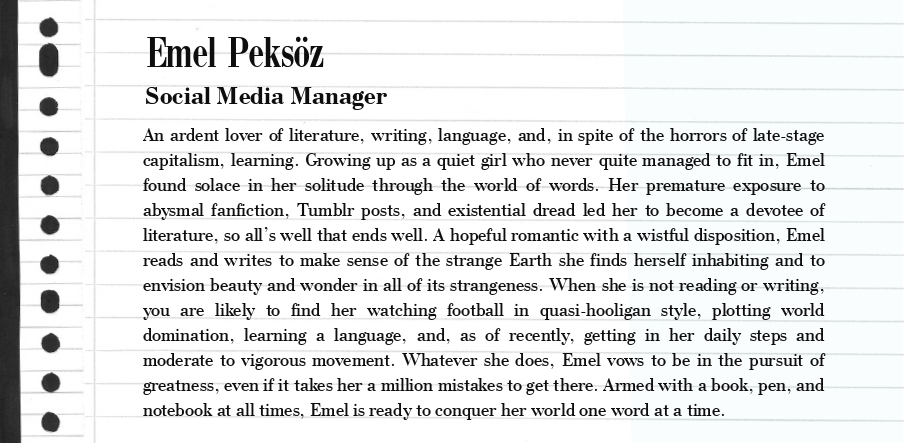
Written by Emel Peksöz
References
Ahmed, Sarah J., and C. Dominik Güss. “An Analysis of Writer’s Block: Causes and Solutions.” Creativity Research Journal, vol. 34, no. 3, Jan. 2022, pp. 339–54. https://doi.org/10.1080/10400419.2022.2031436.
APA Dictionary of Psychology. dictionary.apa.org/cognitive-restructuring.
Baldwin, James. “James Baldwin, The Art of Fiction No. 78.” The Paris Review, 1984, http://www.theparisreview.org/interviews/2994/the-art-of-fiction-no-78-james-baldwin.
Bergler, Edmund. “DOES ‘WRITER’S BLOCK’ EXIST?” American Imago, vol. 7, no. 1, 1950, pp. 43–54. http://www.jstor.org/stable/26301237.
Institute for Quality and Efficiency in Health Care (IQWiG). “In Brief: Cognitive Behavioral Therapy (CBT).” InformedHealth.org, 21 Aug. 2025, http://www.ncbi.nlm.nih.gov/books/NBK279297.
May, Rollo. The Courage to Create. 1975.
Rahmat, Noor Hanim. “Writers’ Block for Writers: How Far Is It True?” Global Journal of Social Sciences Studies, vol. 6, no. 1, Jan. 2020, pp. 51–63. https://doi.org/10.20448/807.6.1.51.63.
Rose, Mike. Writer’s Block: The Cognitive Dimension. SIU Press, 2009.
Winnicott, Donald. Playing and Reality. Westview Press, 1971.
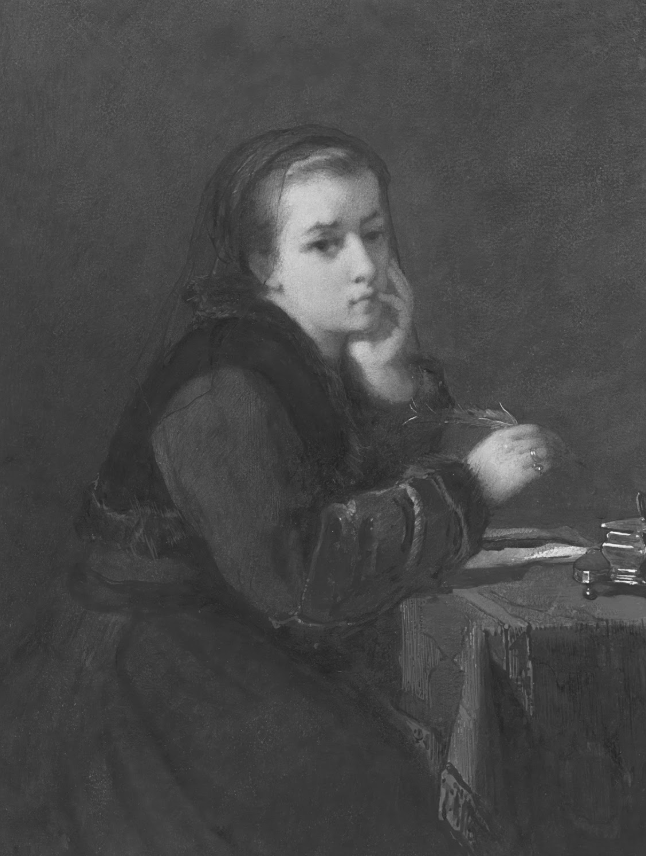
“Young Woman Writing at a Desk With a Typewriter.” Unsplash, uploaded by Europeana, illustrated by Kate Bisschop-Swift, 2025, unsplash.com/photos/young-woman-writing-at-a-desk-with-a-typewriter-fOfQl7NjOdE.


Leave a comment