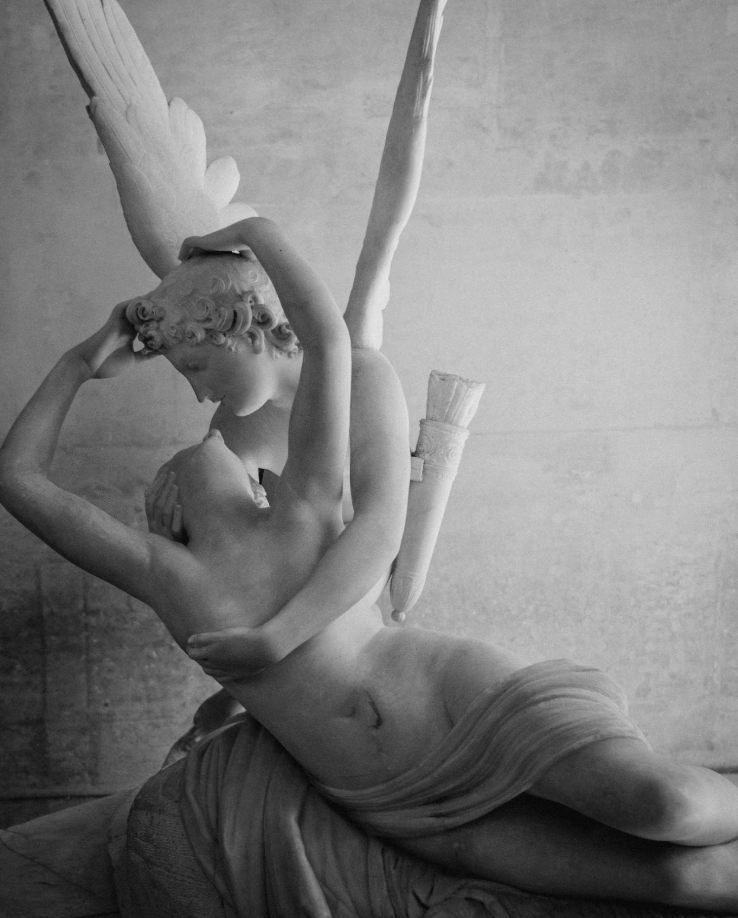
At the start of September, I went to my first Monday lecture of the new academic year. I was met with the bold declaration that love is, in fact, a bitch. Our lecturer, the terrific Dutch scholar Margriet van Heesch, did not sugarcoat her words. She might have even saltcoated them. Her message was clear: love is not a fairy tale, you are pretty much destined to get your heart broken a gazillion times, it will not suck any less on the umpteenth time, and this is most definitely not a self-help course. Granted, I didn’t expect any less when I enrolled to take an elective named Love is a Bitch!: Romance, Sexuality and Desire in Popular Culture at the University of Amsterdam. What you see is what you get. Sort of.
In spite of Van Heesch’s seemingly sceptical takes on love, there is something visionary, and perhaps even idealistic, about the course. In the comfort of the lecture hall with a door that has a life of its own, to be non-normative is the norm. Van Heesch offers us a lens where all of us are neurodivergent, Rutte is the “queerest of them all,” and we can finally ask ourselves the fundamental questions underlying contemporary society, such as: why does Jay-Z never wear a bathing suit?
As you can tell, van Heesch is a blast to witness and a great kickstart to my week. Far from needing a cup of coffee to stay awake during her lectures, she is the caffeine. Mondays have never been this fun before. The best part of it all? In the same society where PVV gets 37 seats in the Dutch parliament, there is still a learning space where we are encouraged to queer and decolonise our thoughts.
Frankly, when I enrolled in this course, it was entirely with the intention of indulging in a topic of my liking. Nearing the finish line of the course, however, I realise that a course like this is a necessity. Love is not a private affair. It permeates the public and, no doubt, the political. Understanding love requires acknowledging the power structures that shape it. A comprehensive and honest view of love is facilitated by connecting our inner and outer worlds. In a society that seeks to constrict the stories we are told and the realities we live, the Love is a Bitch! lessons cultivate the resistance and reimagination of love beyond the normative narratives. These lessons offer liberty—if only the freedom of our minds—together with the power to reclaim space for ourselves and a love that is more diverse, inclusive, and our own. Over the span of only six weeks, I discovered that a course can be a shelter in the storm.
Tuesdays are for seminars. My seminar teacher, the wonderful Jen Maaskant, has a Love is a Bitch playlist filled with students’ song recommendations inspired by the course. The playlist ranges from Joy Division’s Love Will Tear Us Apart to Antonio Vivaldi’s Winter. I am now a firm believer that having a playlist for each course should be state policy. Doing your course readings hits different when there’s a curated course playlist playing in the background.
On unsuspecting Tuesday afternoons, from one to three, my classmates share their perspectives and thoughts on love, and it expands my world a little bit more each time. We venture beyond the familiar to engage with a variety of thinkers and schools of thought, but we are also given the opportunity to learn from one another and ourselves. We come from a diverse range of disciplines and backgrounds. None of us have the exact same experiences with love, heartbreak, coupledom, or singlehood. In the vibrant fusion of voices, it is both our differences and similarities that augment my knowledge. Love takes on many forms, and exploring its multiplicity in a two-hour seminar is no easy feat, but we give it our best shot.
The sincerity of the curiosity of my classmates invigorates me. I’d love to know why my classmates chose this elective and what it is about romance and sexuality that interests them. More than anything else, I want to know where to find people like this when the curtains close again. I may or may not have entered the dream world of my inner child, and I am reluctant to leave. In the back of my mind, I see thirteen-year-old Emel, and she is having the time of her life. In front of me, I see love everywhere. Although our classes focus on romantic love, I have the pleasure of witnessing love in its all-encompassing sense.
Of course, I learnt a great deal about romantic love. The subject is enthralling, and even aside from the revival it has enkindled in me, I would recommend this course to anyone intrigued. But I cannot overstate that this course gave me much more than riveting facts and insights. Beneath the fun pop culture references and class discussions, I was given a safe space to think from a place of diversity and inclusivity. Amidst a political climate that leaves me feeling unsettled, weary, and powerless, I caught a glimpse of what lies beyond the doom.
In the presence of a variety of enriching perspectives, I felt awake and hopeful. It opened the door to a sight I hadn’t seen in some time. I came face-to-face with my own perspective, one that I have often left on the back burner in other classrooms and lecture halls in favour of academic rigidity.
According to Michael Gratzke, “love is what people say it is.” Though he is primarily talking about romantic love, I believe his words resonate beyond the realm of romance. To grasp or discuss love in its entirety is not an endeavour I intend to pursue, but I hope to capture glimpses of love in the world around me whenever it is within reach. As I linger on the love I have sensed in the past few weeks, I can discern the thread that weaves these experiences together.
As with anything in life, there are hard times and good times, but to me, one thing always rings true: love brings ease in the midst of hardship. If I do not know how to describe love, I at least know where to find it. In the difficulties of September, this course brought some ease. The aftertaste of these experiences has become a promise of what is to come, regardless of what the future holds. Love is there, and it does not abandon us.
Special thanks to Margriet van Heesch, Jen Maaskant, and all of my fellow coursemates for making the Love is a Bitch! course an unforgettable experience. You reignited a sliver of my hope in humanity. Consider my gratitude insurmountable. So long!
Written by Emel Peksöz
References
Gratzke, M. (2017). Love is what people say it is: Performativity and Narrativity in Critical Love Studies. Journal of Popular Romance Studies, 6, 1–20. https://hull-repository.worktribe.com/preview/1164653/LIWPSII.4.2017.pdf
Silva, W. (2022). Statues of Cupid and Psyche. Pexels. https://www.pexels.com/photo/statues-of-cupid-and-psyche-14506129/
Van Heesch, M. (2025). Love is a Bitch! Lectures.


Leave a Reply