Content Warning!
Milk gone sour, curdling into yellow clots, emanating a sweet, putrid reek. A knot of pale larvae, slick, sticky bodies writhing together, blind mouths chewing and gulping. A spider overturned, legs ticking and curling inward like coarse burnt hair. An exposed wound, sickly warmth pulsating, raw flesh glistening in the light. A splintering crack of bone collapsing under sudden pressure, protruding through pimpled skin. A corpse, its last gurgle of vitality fading into silence, clouded eyes filmed with gray, mouth slack with the stillness of decay. A pedophile residing in the shadows, beads of sacrilegious sweat dousing his collar, around the dog piss-stained corner, out of sight, enlarged pupils glued to his next victim. A killer daydreaming of the metallic stench of death, blade slipping, sinking into the smooth softness of living skin, now nameless ribbons of meat.
Disgust is one of the most visceral human emotions, a reaction capable of collapsing the distance between sensation and thought in an instant. It is also one of the most layered experiences of the human condition—a matryoshka doll of biological reflexes, psychoanalytic boundaries of the self, and the sociocultural structures that transform repugnance into moral judgment, that will be assembled from its core to its outer layer with the aid of cinematic representation. Cinema combines soundscapes, character-driven narratives, symbolic meaning, and visual imagery to provoke an instinctive reaction and bring to the surface the tension between the spectator and the object of revulsion. The core of this construction is the biological mechanisms that possibly shaped disgust as a survival instinct.
1: Evolution and Child Development
Charles Darwin’s 1872 book The Expression of the Emotions in Man and Animal is widely accepted to contain the first study on the psychology of disgust. However, it only grapples with the physical reaction to offputting, primarily oral or olfactory stimuli. His studies suggest multiple points of interest. His notes on his own travels, as well as the intel from his correspondents indicate that the expression of disgust is universal — vocal, facial and bodily reactions across cultures involve acts such as: “the mouth being widely opened, as if to let an offensive morsel drop out… guttural sounds … ach or ugh ; and their utterance is sometimes accompanied by a shudder, the arms being pressed close to the sides and the shoulders raised in the same manner as when horror is experienced…movements round the mouth identical with those preparatory to the act of vomiting” 1. Secondly, Darwin suggests that the extreme reaction of retching or vomiting with no real cause (bacteria, overeating, excessive richness of the food, etc.) could be occurring due to “pregenitors” who had the ability to voluntarily expel food or drink that “didn’t agree with them” 1. As confirmation for that theory, he writes that “the monkeys in the Zoological Gardens often vomit whilst in perfect health, which looks as if the act were voluntary” 1. This ability has been deemed unnecessary for human survival, which is why humans cannot voluntarily vomit, but the “habit” to react in a similar manner to unpalatable odors or flavors has remained.
Studies from the 20th century on disgust based on evolutionary theory such as Rozin P. & Fallon A. E. (1987) have put forward the idea that aversion to rotting organic matter, as well as vermins and insects comes from contagion avoidance, which humans have evolved to experience 2. However, according to Rottman (2014), this theory becomes controversial when cross examined through the lens of developmental theory. Rottman writes that “[disgust] does not appear to develop by the point in childhood when humans are most susceptible to the dangers of ingesting pathogens. Additionally, evidence suggests that disgust evolved such that many of its elicitors are primarily shaped through social learning, rather than being biologically prepared” 3. This re-evaluation suggests that the psychological processes behind disgust are more complex and multi-dimensional. Yet even if many disgust responses are shaped through cultural learning, the emotion remains closely tied to fears of contamination and disease.
Cinema frequently exploits this anxiety, particularly in narratives centered on infection and plague. The cinematic case study for this section is the 2012 found footage film The Bay directed by Barry Levinson. It is set in a town in Maryland, a town dependent on its water supply. Chicken excrement from a nearby farm ends up in the bay, which contaminates the drinking water, causing an outbreak of a mysterious virus that causes skin boils and eventually death. The lesions are repulsive and the spread of the disease causes mass hysteria. It is later revealed that the symptoms were caused by tongue-eating isopods, which had mutated after being in contact with the droppings, since the chickens had been fed steroids for rapid growth. This turn of events reveals that the parasites were the cause of the wounds, as they were eating through the bodily matter of their hosts. It also explains the peculiar symptom some of the characters describe — the feeling of bugs crawling underneath their skin. Each revelation about the disease seems to attack a different anxiety connected to contamination. Most plague movies thrive on the spectacle of mass death and grotesque symptoms. They force the viewer to think about the various possible illnesses that one could contract, causing fear of everyday items or materials such as water and meat, and interaction with individuals or animals that seem like infection carriers. Plague narratives therefore activate disgust by presenting the body as vulnerable to invasion by external contaminants. Yet the horror of infection reveals something deeper than the fear of disease alone—it exposes the fragile boundary separating the body from the outside world. When parasites burrow beneath the skin or pathogens circulate through the bloodstream, the distinction between inside and outside begins to collapse.
2: Abjection and the Self
The evolutionary explanation of disgust focuses primarily on the avoidance of disease, but psychoanalytic theory approaches the emotion from a different perspective. In French-Bulgarian psychoanalytic scholar Julia Kristeva’s long form essay Powers of Horror: An Essay on Abjection, disgust emerges when the boundary between the self and the other begins to collapse. Her theory of abjection builds upon the psychoanalytic framework of Jacques Lacan, particularly his concept of the mirror stage. According to Lacan, infants begin to form a sense of identity when they recognize their reflection and identify with the image of a unified body. This identification is ultimately a misrecognition, because the infant’s bodily experience remains fragmented and uncoordinated, yet the mirror presents an external image of wholeness. Nevertheless, this moment establishes the ego by separating the self from the surrounding world. Kristeva expands this account by emphasizing the role of rejection in the formation of identity. For Kristeva, the subject emerges not only through visual identification but also through acts of rejection that mark the boundary of the body. In moments of nausea or vomiting, the body violently expels what it refuses to incorporate, and the resulting substance becomes abject: “During that course in which ‘I’ become, I give birth to myself amid the violence of sobs, of vomit” 4. That is why she stipulates that “food loathing” is the most archaic process that leads to abjection. Yet abjection is also inherently destabilizing. Substances such as bodily waste, blood, or vomit disturb us precisely because they blur the distinction between inside and outside, self and non-self. The substances that threaten the newly formed boundaries penetrate the continuity of the corporeal form. Ultimately, the self emerges through rejection and is simultaneously disturbed by expulsion. Skin, as the outermost layer of the body, functions as the body’s primary boundary, preventing the occurrence of abjection. What happens when that boundary is impeded?
A striking cinematic illustration of this disturbance of bodily boundaries appears in the 1991 film The Silence of the Lambs, directed by Jonathan Demme. The film follows FBI trainee Clarice Starling as she pursues the serial killer known as Buffalo Bill. Unlike many horror antagonists whose violence is primarily associated with the act of killing itself, Buffalo Bill’s crimes revolve around a more unsettling form of bodily violation—he murders women and flays their skin in order to construct a “woman suit” that he intends to wear. Within the logic of Kristeva’s theory, this act produces a powerful form of abjection because it destroys the body’s most fundamental boundary. Skin preserves the integrity and intelligibility of the self. The victims are stripped of their identity, which is stolen by Buffalo Bill, who is obsessed with the symbolism of caterpillars, envisioning his own transformation as a deeper one than just wearing a garment made of women’s skin. He simultaneously reduces his victims’ bodies to raw biological matter and gives symbolic gendered meaning to their skin. This psychological phenomenon reveals the intricacy of the abject and how it can be a transformative process from various perspectives.
3: Animality and Social Depravity
The psychological study of disgust also identifies a category known as animal-reminder disgust, which emerges when humans are confronted with evidence of their own biological nature. Rather than responding to contamination alone, this form of disgust arises when the human body is revealed as fragile, mortal, and governed by the same biological processes as other animals. Studies such as Bunmi O. Olatunji et al. (2008) describe this reaction as a response to stimuli that “remind us of our animal origins and our inevitable mortality” 5. Bodily fluids, decay, sexual exposure, and excretion become disturbing because they undermine the illusion that human beings exist as purely rational or dignified subjects, on top of the hierarchy of the animal kingdom. In this sense, disgust protects not only the body but also the symbolic distinction between humanity and animality. Closely related to this reaction is the phenomenon of moral disgust, in which the same visceral response is directed toward ethical violations rather than physical substances. Legal scholar William Ian Miller in his book The Anatomy of Disgust, argues that disgust functions as a social defense mechanism, writing that one should “imagine morality without disgust for evil” to understand how essential this reaction is for maintaining social order 6. Acts such as murder, sexual violence, and humiliation provoke disgust even when they are only described, out of sight, suggesting that the emotion helps enforce the boundaries of acceptable behavior. When combined, animal-reminder and moral disgust reveal how the corporeal form becomes a central site for the construction of dignity and humanity within society.
A notorious cinematic example of this perspective on disgust is Pier Paolo Pasolini’s 1975 film Salò, or the 120 Days of Sodom. Set in the fascist Republic of Salò during the final years of World War II, the film follows four powerful libertines who abduct a group of teenagers and imprison them in a secluded villa, where they subject them to escalating rituals of humiliation, sexual violence, and torture. Rather than presenting violence as spectacle, the film focuses on systematic degradation—the captives are forced to behave like animals, dine out of dog bowls, stripped of their clothes, and compelled to consume human excrement during a grotesque banquet. These acts deliberately invoke animal-reminder disgust by reducing the victims to biological bodies defined by hunger, excretion, and pain, leaving no space for humanity to blossom. At the same time, the fascist perpetrators occupy a position of detached authority, observing the suffering through binoculars and transforming degradation into a ritual of power. The victims’ bodies become abject matter, deprived of dignity and agency, while the libertines maintain their authority by symbolically placing themselves outside the realm of animality and vulnerability. In this way, the film exposes how disgust can be manipulated as a political weapon—by forcing their victims into states associated with animal-reminder disgust, the fascists destroy their human dignity and reinforce a brutal social hierarchy that can only result in helplessness.
4: Matryoshka Doll
Each layer of disgust encloses another—the biological instinct to avoid contamination, the psychoanalytic struggle to maintain the boundaries of the self, and the social mechanisms that transform revulsion into moral judgment and political control. What begins as a reflex to protect the body ultimately becomes a way to police dignity, humanity, and power. Cinema exposes these layers with particular intensity, confronting the spectator with images that force the body to react before the mind has time to interpret them. Beneath the carnavalesque quality of body horror, made up of rot, wounds, parasites, and degradation lies a deeper discomfort—the recognition that the fragile boundary separating the human from the animal, the subject from the object and dignity from abjection can collapse at any moment.
Written by Ema Peteva
Cover Art:
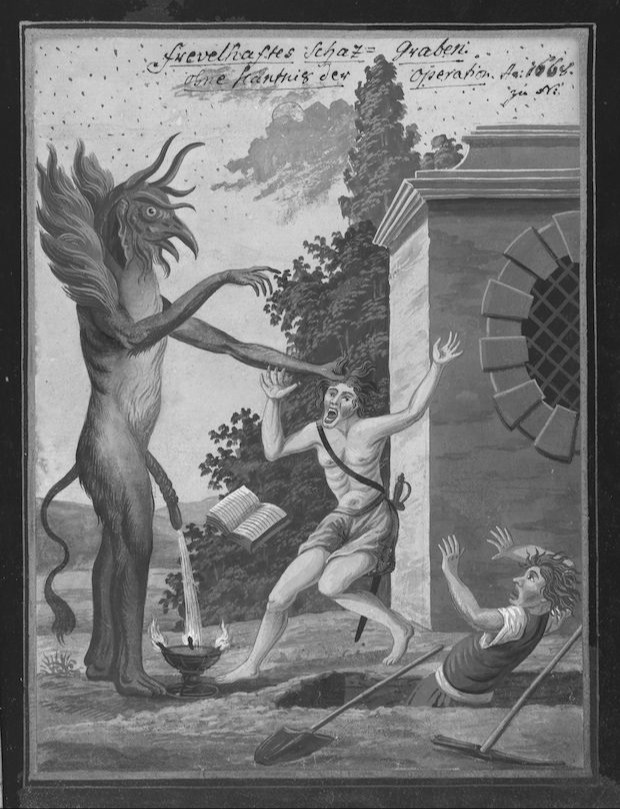
Collection: Compendium rarissimum totius Artis Magicae sistematisatae per celeberrimos Artis hujus Magistros (ca. 1775) from Public Domain Image Archive https://pdimagearchive.org/images/4a66a6ce-60af-4657-bdc7-55c8880d813b/
References:
- Darwin, C. (1872). The expression of the emotions in man and animals. John Murray eBooks. https://doi.org/10.1037/10001-000
- Rozin, P., & Fallon, A. E. (1987). A perspective on disgust. Psychological Review, 94(1), 23–41. https://doi.org/10.1037/0033-295X.94.1.23
- Rottman, J. (2014). Evolution, Development, and the Emergence of Disgust. Evolutionary Psychology, 12(2), 417-433.
- Kristeva, J. (2018). “Approaching Abjection,” from Powers of Horror: An Essay on Abjection. In Amsterdam University Press eBooks (pp. 67–74). https://doi.org/10.1515/9781942401209-010
- Olatunji, B. O., Haidt, J., McKay, D., & David, B. (2008). Core, animal reminder, and contamination disgust: Three kinds of disgust with distinct personality, behavioral, physiological, and clinical correlates. Journal of Research in Personality, 42(5), 1243–1259. https://doi.org/10.1016/j.jrp.2008.03.009
- Miller, W. I. (1997). The anatomy of disgust. Harvard University Press.
- Laine, T. (2026, March 9). The Five Senses of Cinema: Taste [Lecture].

 Writer's Block Magazine
Leave a comment