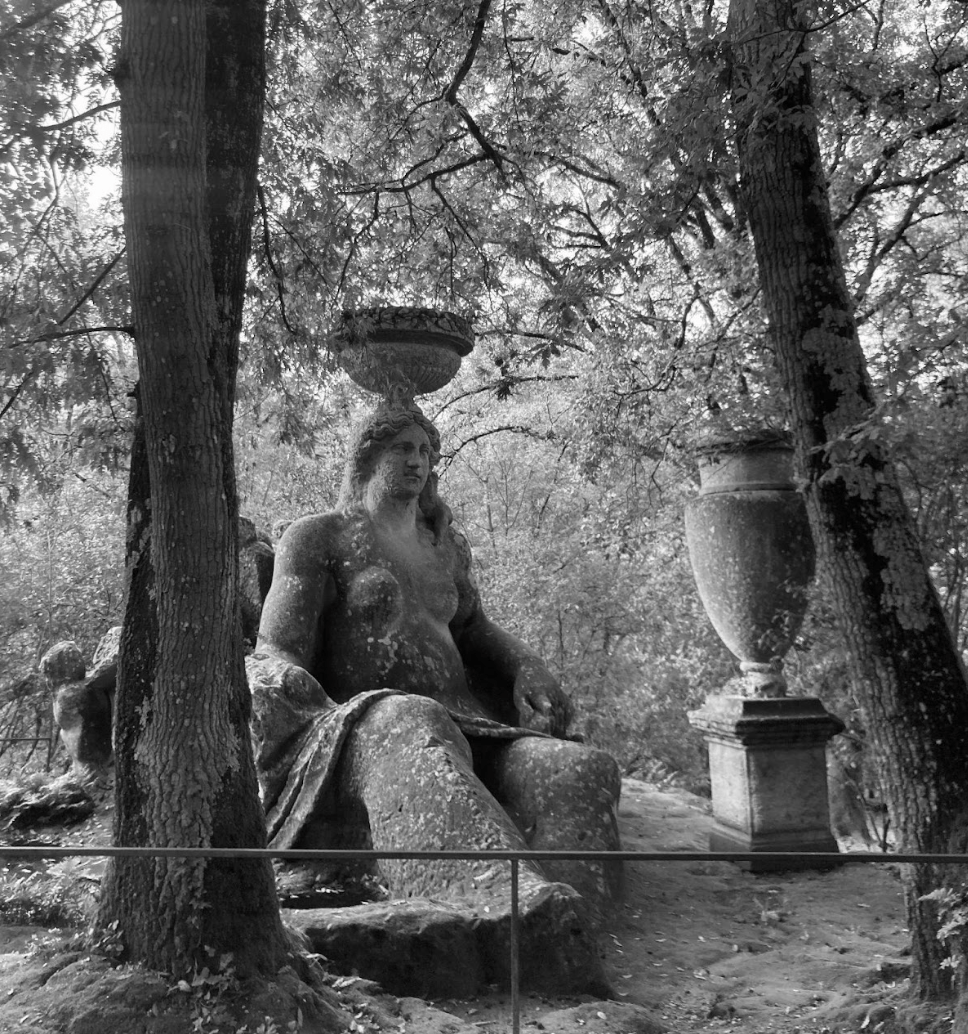
“I wrote a story of the Resurrection, where Jesus gets up and feels very sick about everything, and can’t stand the old crowd any more – so cuts out – and as he heals up, he begins to find what an astonishing place the phenomenal world is, far more marvellous than any salvation or heaven – and thanks his stars he needn’t have a ‘mission’ any more.”
Lawrence, Letters 6: 3 May 1927, p. 50
Floating in the sea with my ears submerged, my eyes closed and the burning sun on my face. The world is muffled, half of my body is enveloped in liquid coolness and the other half is scorched by rays of heat and light I can feel but not see. All is darkness and dim sounds of happiness and waves. My mind clears, my body feels. There are very few moments, if any, when I find myself so at peace. I began the year with D.H. Lawrence’s Women in Love (1920) and it has truly changed me. Not necessarily because the ideas in it were unknown to me; but they were always unformed in me. They were feelings mostly: the thrill of holding hands in silence, warm tears at the sight of silvery hills of olive trees, the imperceptible melting into an endless sunny field. What Lawrence gives form to is the recognition that sensuality is not an ornament of life but one of its primary modes of knowledge. To feel the world through the body is to discover that the self is not sealed within its own borders but already extended into the living field around it. The sensual moment loosens the rigid architecture of individuality, preparing the way for the surrender of the isolated self into the wider, circulating processes of life and death that sustain it.
It is a fulfilment—the great dark knowledge you can’t have in your head—the dark involuntary being. It is death to oneself—but it is the coming into being of another… [it is knowledge] in the blood… when the mind and the known world is drowned in darkness—everything must go— there must be the deluge… There’s the whole difference in the world, he said, between the actual sensual being, and the vicious mental-deliberate profligacy our lot goes in for… You’ve got to lapse out before you can know what sensual reality is, lapse into unknowingness, and give up your volition. You’ve got to do it. You’ve got to learn not-to-be, before you can come into being. But we have got such a conceit of ourselves—that’s where it is… We’ve got no pride, we’re all conceit, so conceited in our own papier-mâché realised selves. We’d rather die than give up our little self-righteous self-opiniated self-will (Women in Love, pp. 46-8).
D. H. Lawrence passionately argues in his Apocalypse (1931), that civilization is better measured by “vital consciousness” than by technological invention, claiming that modern humanity’s awareness is wide but shallow, lacking the depth of instinct, intuition, and image-based knowledge that defined archaic thought. Lawrence’s critique points to a fundamentally qualitative, organic cast of mind in ancient peoples, one that stands in opposition to the quantitative, linear orientation of modernity. This is closely related to another concept he believed in: hylozoism, the pre-Socratic view that all matter is alive and that life and matter cannot be separated. As Henri Frankfort observes, ancient man did not draw the inner/outer, subject/object distinctions central to modern thought; instead, he understood humanity as embedded within society, and society as embedded within nature and cosmic forces, so that natural phenomena were interpreted through human experience and human experience through cosmic events. Primitive man simply did not conceive of an inanimate world, and for that very reason had no need to personify phenomena — because personhood was already their natural mode of being. Lawrence extends this sensibility into his own cosmology in his Fantasia of the Unconscious (1922), insisting that the sun is not a material ball of blazing gas but an intense pole of cosmic energy, and that to the moon belong the forces of magnetism, electricity, and radium-energy — rejecting the reductive materialist picture of science in favor of a living, dual cosmos in which matter and force, life and death, remain inseparable.
Lawrence was also inspired by Heidegger’s conception of “world,” which resists any separation of external existence from human being within it. Just as the ancients could not conceive of an inanimate world standing apart from human consciousness, Heidegger struggled with — and, significantly, acknowledged the impossibility of — translating a pre-metaphysical mode of being into modern terms, a struggle that, like Lawrence’s, sharpened his awareness of how contingent and limited our habitual picture of reality truly is. This tension between modes of consciousness is not merely philosophical but psychological: the unconscious mind lives and thinks in ways that can be called primitive, and is fundamentally at odds with many of the demands civilization places upon it. Lawrence gave this conflict its own vocabulary, distinguishing between “mind-consciousness” and “blood-consciousness” — two radically incompatible orientations that, he argued in Studies in Classic American Literature (1923), wage an unceasing inner psychic war within every human being, a condition he grimly described as “our cross.” He sustained that where blood-consciousness overwhelms and annuls the mind, mind-consciousness extinguishes and consumes the blood. Yet late in his life, he recognized that instinct alone cannot sustain a being who also possesses a mind, concluding that the only viable path forward was to “marry the pair of them.”
This understanding of a consciousness rooted simultaneously in the body and the cosmos finds its ethical dimension most fully elaborated in Lawrence’s fiction. He believed genuine ethical action does not originate in obligation to the other but in a prior attunement of the self to the universe, and it is only once a person has become aware of his or her body — both as physical object and metaphysical subject — that recognition of the other becomes possible at all. Ethics is intended here in the original Greek meaning of the word: action arising from one’s basic, essential character, which is itself the product of a conscious awareness emerging from something profoundly unconscious. Lawrence’s character Tom Brangwen, from his 1915 novel The Rainbow, illustrates this precisely: Tom’s response to his wife Lydia is not the measured recognition of an other to whom he bears responsibility, but something indefinite, non-human, almost animalistic, a response that finds its source not in moral deliberation but in the placement of his body within the greater natural realm — the asymmetrical, irrational, cosmic dimensions of existence. This resonates with Schopenhauer’s account, in The World as Will and Representation (1818), of rare individuals who are, like Tom, capable of stilling the wild energetic urgings of essential nature and thereby achieving a heightened communion with earth and universe — a calming of the will that opens onto something larger than the self.
This movement toward the other through the cosmos, this metaphysical consciousness, is an extraordinary comprehension that overcomes what already is in order to enter an endless process of becoming, a re-genesis of the self that follows no fixed code but relies instead on images, metaphors, and symbols — precisely the mode of knowledge Lawrence shared with the ancients — and that culminates in a figurative and literal grasping of humanity, an ethical inclusiveness capacious enough to hold self, other, and universe together. In his “Psychology of the Child Archetype” (1940), Jung also posits an essence that takes precedence over the material world, so that in primitive humanity the unconscious manifests a reality superior to the external and so-called real world; Lawrence embraces precisely this idea of a primitive, elemental essence that is neither learned nor acquired but slowly revealed through the magic exchange between objective and subjective knowledge, adapting and contributing creatively to existence. This essence is at once singular in the individual and immense across the entire chain of humanity, so that being human becomes an ongoing process of discovering, seeing, understanding, and feeling one’s cosmic and individual existence simultaneously.
We always consider the silver river of life, rolling on and quickening all the world to a brightness, on and on to heaven, flowing into a bright eternal sea, a heaven of angels thronging. But the other is our real reality… that dark river of dissolution. You see it rolls in us just as the other rolls—the black river of corruption… When the stream of synthetic creation lapses, we find ourselves part of the inverse process, the blood of destructive creation… You are a devil, you know, really, she said. You want to destroy our hope. You want us to be deathly. No, he said, I only want us to know what we are. Ha! she cried in anger. You only want us to know death (pp. 192-4).
Dissolution, for Lawrence, appears as an internal principle of vitality itself, an inverse movement through which life continuously undoes and remakes its own forms. In his “Beyond the Pleasure Principle” (1920), Freud understood the death instinct and the pleasure principle as equally fundamental to the vacillating rhythm of life, yet argued that the pleasure principle ultimately serves the death instincts, conceiving the drive to move beyond pleasure as an urge inherent in organic life to restore an earlier, inorganic state of things. Lawrence translates this theoretical framework into embodied experience in Kangaroo (1923). Somers imagines men returning from the First World War brutalized and hollowed, having lost not their courage — of which there was plenty in facing death — but something more essential: their inward, individual integrity and the courage to face their own isolated souls and abide by those souls’ decisions. Frieda Lawrence, echoing this sensibility, saw in the war a dark but genuine gain: a new reincorporation of death into life, a recovery of the ancient understanding that death is not something that comes after life, as Christian doctrine would have it, but is always already present within it. This critique of Christianity is central to Lawrence’s post-Nietzschean modernism: where ancient blood-consciousness had held life and death, creation and decay, in dynamic and sacred tension, Christianity severed that connection, becoming for Lawrence not a consolation in the face of death but death itself — as destructive as the industrial machine, and similarly demanding worship, submission, and the suppression of both sensuality and individual consciousness.
There is life which belongs to death, and there is life which isn’t death. One is tired of the life that belongs to death—our kind of life. But whether it is finished, God knows. I want love that is like sleep, like being born again, vulnerable as a baby that just comes into the world… Why should love be like sleep? she asked sadly. I don’t know. So that it is like death… It was such peace and heavenly freedom, just to fold her and kiss her gently, and not to have any thoughts or any desires or any will, just to be still with her, to be perfectly still and together, in a peace that was not sleep, but content in bliss. To be content in bliss, without desire or insistence anywhere, this was heaven: to be together in happy stillness (pp. 208-284).
The Etruscan civilization, for Lawrence, embodied the living proof that death need not be severed from life or dressed in the garments of transcendence: as he wrote in Etruscan Places (1932) — a book Paul Fussell aptly characterizes as being about “dying happily” — the Etruscans conceived of death as neither heavenly bliss nor purgatorial torment but simply a natural extension of the fullness of living, everything still rendered in terms of life. This Etruscan idea of vitality finds its fullest expression in The Escaped Cock (1929), where Lawrence’s Christ, freed from both godhood and the dead corpse of love that the passion on the cross had produced, enters into a mystical, sensual, and instinctual relationship with the phenomenal world, rising in the flesh, as well as the spirit: Christ discovers the reality of soft, warm, tactile love, and in the depths of his loins his own sun dawns, “magnificent, blazing, indomitable.”
What emerges across Lawrence’s philosophy, psychology, and fiction is a vision of human existence grounded not in transcendence but in participation. In relinquishing the rigid sovereignty of the isolated self, one does not vanish but enters more deeply into the living continuum that surrounds and sustains it. Sensuality, in this sense, becomes an embodied awareness that life is richest precisely where it risks dissolving its own boundaries.
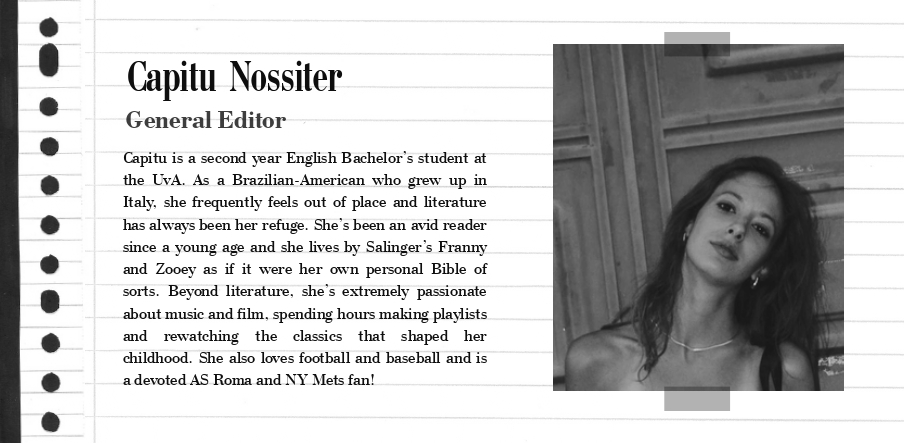
Written by Capitu Nossiter
References:
Friedman, Alan W. “D. H. LAWRENCE: PLEASURE AND DEATH.” Studies in the Novel, vol. 32, no. 2, 2000, pp. 207–28. JSTOR, http://www.jstor.org/stable/29533391.
Gutierrez, Donald. “The Ancient Imagination of D. H. Lawrence.” Twentieth Century Literature, vol. 27, no. 2, 1981, pp. 178–96. JSTOR, https://doi.org/10.2307/441138.
Kessler, Jascha. “D. H. Lawrence’s Primitivism.” Texas Studies in Literature and Language, vol. 5, no. 4, 1964, pp. 467–88. JSTOR, http://www.jstor.org/stable/40753781.
Lawrence, D.H. Women in Love. Penguin Books, 1960.
Tague, Gregory. “Metaphysical Consciousness in the Work of D.H. Lawrence.” The D.H. Lawrence Review, vol. 32/33, 2003, pp. 126–38. JSTOR, http://www.jstor.org/stable/44234514.
Travis, Leigh. “D. H. Lawrence: ‘The Blood-Conscious Artist.’” American Imago, vol. 25, no. 2, 1968, pp. 163–90. JSTOR, http://www.jstor.org/stable/26302479.
 Writer's Block Magazine
Leave a comment