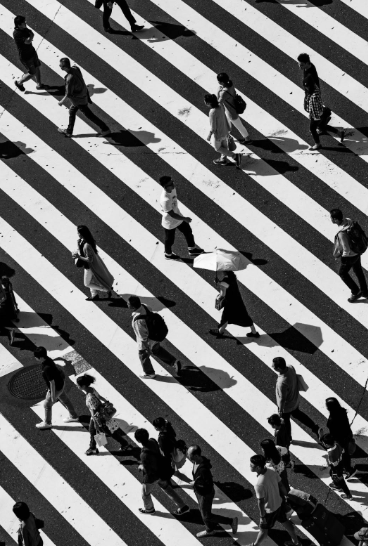
Time doesn’t make money. Money makes time.
We have not been living in the present moment for a long time now. Humanity is constantly drawn out of its current state, into a hyperreality governed by the screens in our pockets, a consciousness displaced into someone else’s life, another country’s environment. We spend hours mindlessly scrolling, as time sifts through our fingers into oblivion.
I recently rewatched one of my favourite movies, “In Time,” in which the premise lies on a world built around time as a currency. Most people live day to day, hour to hour, minute to minute, while the aristocracy has a century on their personal clock to spend as they wish. Everyday, the government raises the price of commodities, a minute more each day, and while the rich get richer, the others’ time runs out and they fall to their death in the middle of the street.
Will Salas, the protagonist, spends all of his time running – he cannot afford to spare any second. He shares all of his time with his mother: just by bringing their arms close to one another, they can transfer days, hours or minutes, yet they both live with less than a day on their arm. After Will’s encounter with an aristocratic man, he receives a century from him as the man decides to take his life. Will finally discovers what it is like to experience the comforts of life: not opulence and luxury, but sleeping in, eating slowly, walking at a normal pace.
The society in which we live deeply resembles the time-governed world of this 2011 movie. We spend our lives wasting away, while millionaires become billionaires, and billionaires become centibillionaires. In December 2025, Elon Musk’s net worth reached $600 billion – this means that if you spent $10k a day, it would take 164.400 years to spend all of his current net worth. Meanwhile, the ordinary individual lives paycheck to paycheck, choosing the cheapest product on the shelf and hoping to make it last as long as possible.
Nonetheless, I’ve noticed that we do not spend our time running – we spend it in bed, on our phones. Why then, when we know that our time is so limited, do we not start running, doing, living? My guess is, it is exactly the dumbfounding, hopeless concept of inequality. The headline of a recent article from The Atlantic reads: “The Job Market Is Hell.” Young people are working more and earning less, and many more individuals, albeit qualified, cannot even find a job. So why run? Why struggle and fight, when the outcome is the same? The only option is resignation and the result is exhaustion – we waste so much of our energy on surviving that experiencing life is no longer a priority for many. We prioritize school, work, succeeding in our career, working relentlessly towards our goals until we come face to face with the system and the reality of things. Time doesn’t make money, money makes time. The effort and hours we put into creating is no longer equal to becoming wealthy, as automation which can solve issues in seconds has taken over all industries. Instead, the people with money decide how much time the others have; they decide who lives and who dies, who has a house and who does not, and who gets to buy that extra drink on a night out. We take a second job, we work more to afford more, we try balancing it with a hint of a social life. But the truth is, it is never enough. We have tried running, but the finish line is no longer in sight. Might as well just lay in bed on our phones.
Therefore, it is no wonder that it is much easier to find laughter and joy in other places, in other people’s realizations, in others’ experiences. We live a thousand lives daily just by scrolling: someone is in Japan, someone managed to get promoted, a microcelebrity you’ve been following since 2017 just had a baby! And in the midst of your scrolling, you no longer feel so alone; after all, there’s thousands of other people like you in the comments, thinking what you’re thinking, commenting what you would never have the courage to comment, feeling what you’re also feeling. In a world that feels so disconnected, so estranged and in which you feel so alienated, you finally find that sentiment of pseudo-belonging, even if it is just for the 13 seconds that the video lasts.
Now, I do not believe that this is a solution to the issue of our messy and often unfair society. It is rather a by-product, a sort of inevitable outcome and a convenient outlet to suppress the feelings of helplessness and desperation so many of us have. We scroll past the serious videos of war, we laugh at someone’s cat doing tricks. We put all videos on 2x speed, an attempt to see more, to consume more, to feel more. But our world has long disregarded feelings in favour of work, money, success, and therefore humanity is slowly losing the ability to feel properly and have empathy. While I’ve long criticised our need to spend so much time on our phones, I’ve finally started to understand why we do it. The system we were taught to live in no longer works, and it only benefits a small minority, which aims to pull us further apart and run individually in opposite directions. The system has broken down, running is no longer an option. Maybe our personal clocks have also run out, and now we’re living in overtime.
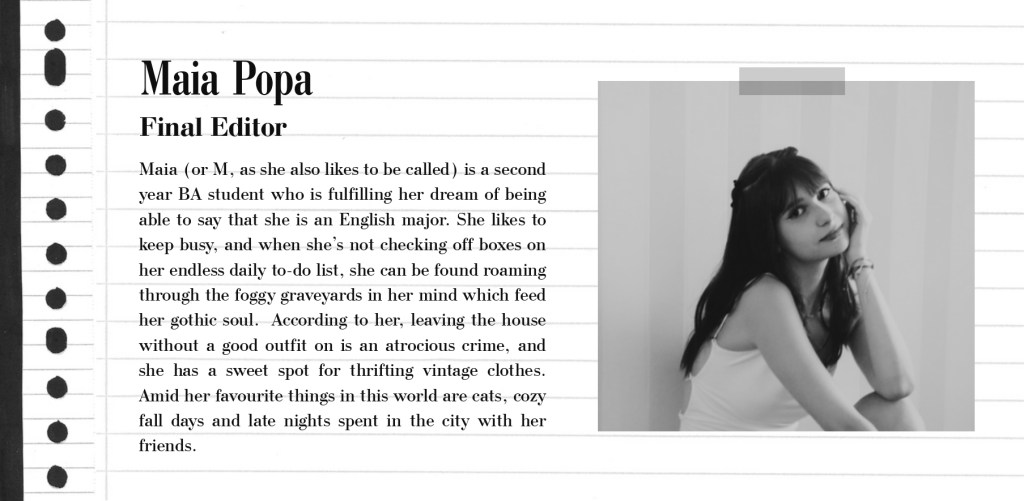
Written by Maia Popa
 Writer's Block Magazine
Leave a comment