
“You are what you love, not what loves you.”
The people, ideas and things you love are inherently a part of you, a reflection of your identity. The attraction you feel towards them, the qualities you admire in them, can be traced to the way your mind, heart and soul work. To love is to give way to yourself. That does not mean the object of your love is you, rather that you are it. The absence or presence of someone’s love for you can shape your identity, but it does not define it. To love passionately requires courage, but to not hinge your opinion of yourself on someone else’s love for you requires a certain strength, a conviction in your sense of self.
I recently rewatched the film Adaptation (2002) and I was struck by a conversation between two characters. Charlie confesses to his brother Donald that he saw the girl he had a crush on in high school make fun of him after speaking with him. He believes he is bursting Donald’s bubble, awakening him to the reality that not having your love reciprocated somehow taints it. Donald, however, says he already knew, he heard her. Charlie is perplexed. “Well how come you were so happy?” He asks. Donald explains he simply loved her and that love was his, he “owned it” and even she “didn’t have the right to take it away.”
Adaptation is a metafictional film directed by Spike Jonze and written by Charlie Kaufman, inspired by the screenwriter’s quest to adapt Susan Orlean’s 1998 nonfiction book The Orchid Thief while contending with writer’s block. Kaufman writes himself into the script as the protagonist, Charlie, played by Nicolas Cage — who also portrays his fictional twin brother. A deeply insecure and pathetic man, Charlie grapples with his inability to connect with women and the nuisance of living with his brother Donald, who, though a tad foolish and naive, has the confidence to go through life unabashedly, a quality which Charlie lacks and envies. Somewhat resigned to the failures of his personal life, Charlie pours himself entirely into Orlean’s world. He wishes to respect her work by letting “the movie exist, rather than be artificially plot-driven,” by writing a script “simply about flowers.” Orlean’s book draws on her investigation into the 1994 arrest of eccentric horticulturist John Laroche and a group of Seminoles (a Native American tribe) in South Florida for illegally collecting rare orchids in the Fakahatchee Strand State Preserve. Through multiple interviews with Laroche, she depicts his fascination with orchids and his obsession with the rare “ghost orchid,” getting a glimpse of true passion for the first time in her life.
Orlean, portrayed by Meryl Streep, writes that she wanted to know what it feels like to care about something so passionately, “to want something as much as people wanted these plants.” Hers is not only an emotional desire, but a philosophical one as well:
“There are too many ideas and things and people, too many directions to go. The reason it matters to care passionately about something, is that it wittles the world down to a more manageable size.”
Orlean struggles with the lack of passion in her life, whilst Charlie struggles with his lack of inspiration in depicting her work. He is deeply touched by her words, but finds himself unable to adapt them into a script. He wants to faithfully portray the beauty Laroche sees in orchids and the beauty Orlean sees in Laroche’s passion, without the addition of Hollywoodean action which, in his eyes, would but stain the purity of her work. He also views this lack of action as an authentic portrayal of real life, where he claims “nothing really happens.” Without action, however, Charlie is lost — both in his script and his life. Often lonely and anguished in the dark of his bedroom, he fantasizes about the women in his life. He imagines sexual encounters with his studio executive, a waitress and Susan Orlean herself, where he receives their praise and affection. His only non sexual romantic fantasy is about the woman he actually loves, Amelia, whom he is unable to declare his feelings to.
Laroche, played by Chris Cooper, is also shown to desire a woman in his life, as he tells Orlean on the phone: “she’d look at me and quietly say yes… and I wouldn’t be alone anymore.” This tender vignette he sketches warms Orlean’s smile through the line. She is aware, however, that, perhaps like women, Laroche “loved the difficulty and fatality of getting [orchids] almost as much as he loved the orchids themselves.” She accompanies Laroche through the Everglades swamps to retrieve the famous ghost orchid, only to be disappointed in its view. Frustrated to not find the same fascination Laroche has with the flower, she quickly loses interest in the project, until he reveals to her that it contains a powerful mind-altering compound, which only himself and the Seminoles are able to extract and turn into a substance. Orlean, under the effect of this psychedelic mixture, views everything around her with intense rapture, finally feeling, however fleetingly, the desired passion for the world which was lacking in her life. If indeed “you are what you love,” the love Laroche has for both the struggle of obtaining an object and the object itself, is an intrinsic part of him, whilst Orlean’s love for, not an object, but the act of loving itself, is an intrinsic part of her.
Despite Orlean being (unhappily) married, the two begin an intoxicating affair which lasts three years, until the Kaufman brothers appear in their lives. Charlie goes to New York to meet Orlean in the hope of receiving help with his writing, but losing his nerve at the last moment, he has his identical twin Donald impersonate him and meet with her instead. Donald, returning from an unproductive meeting and suspecting an intimacy between Orlean and Laroche (although she denies such), pushes his brother to spy on her with him and then follow her to Florida. There, as Charlie gets confirmation of the affair and learns about their drug use, he is spotted by Laroche. A car chase between the couple and the brothers ensues, as Orlean, despairing she should be exposed, orders Laroche to kill them. Whilst both Donald and Laroche (the only two in the quartet who have lived brazenly) ultimately die, Charlie and Orlean reflect on their own lives. Charlie, in hiding, fearing death, confesses to his brother that he’s wasted his life, spending it “paralyzed, worrying about what people think of [him].” Orlean, holding her lover’s dead body, cries she “did everything wrong,” that she wants her life back “before it all got fucked up, [that she wants] to be a baby again… to be new.” Both characters come to the realization that they squandered their lives by not loving passionately, by allowing “ideas and things and people” get in their way. Orlean’s desire to return to the pure state of birth epitomizes this regret, which appears too colossal to overcome without starting over, without living life to its fullest from its very inception.
Laroche, when describing the process of pollination to Orlean, muses:
“How could they know that because of their little dance, the world lives? By simply doing what they’re designed to do, something large and magnificent happens. In this sense, they show us how to live. How the only barometer you have is your heart. How when you spot your flower, you can’t let anything get in your way.”
Although beautifully put, our humanity complicates this seemingly instinctive process of connection. If our flower is a passion, Laroche’s reasoning stands. But what if it’s a person? If we’re designed to follow our hearts, the nature of human romantic relationships inevitably muddles the spotting and pollinating of our flower. What is the right flower for you? What is your ghost orchid? Does it love you back? If it does, is that enough? Will this love work, will it last? If it does not love you back, is it realistic to not allow “anything to get in your way?” If your obstacle is the flower itself, does that not mean that it is probably not the right flower for you? What is then, again, your ghost orchid?
The process is painful but not one we should give up on. By loving profoundly, by simply spotting our flower, “something large and magnificent” does happen. We may not be sustaining the world ecologically, but we are living our lives to their fullest. We are experiencing human connection without societal or self-imposed inhibitions.
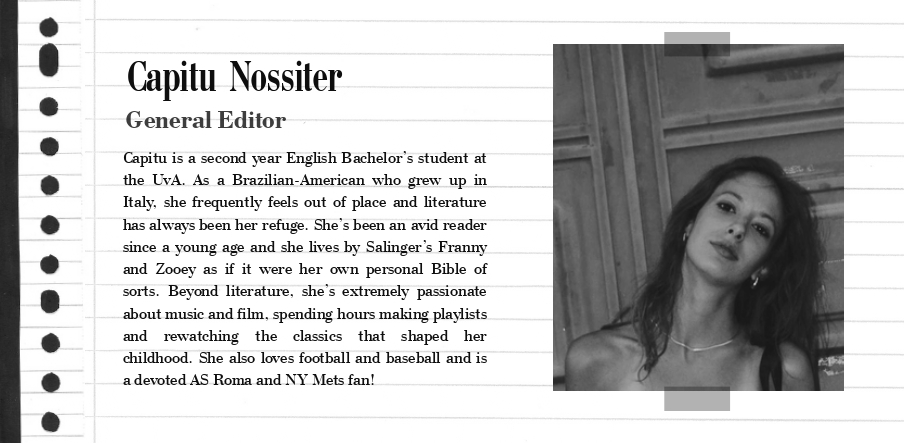
Written by Capitu Nossiter
 Writer's Block Magazine
Leave a comment