“Here lies the roots of a growing divergence between Jew and Israeli;
the former with a sense of mission as a Witness in the human wilderness,
the latter concerned only with his own tribe’s welfare.”
My notion of Judaism was shaped from an early age by my father, a secular Jewish-American who grew up in Europe. He taught me and my siblings that a Jew can feel himself the inheritor of a long tradition of Jewish cultural and ethical transmission while rejecting the notion of either racial or religious identity. He transmitted to us the pain and the joy of being Jewish. He told us how children used to throw stones at his mother as a young girl going to school, how in many instances of his own life, he was targeted for being Jewish, and how we should expect the same in our lifetime. We thus grew up with a deep-seated belief that to be Jewish was to be the underdog. From this, we learned the courage required to persevere and thrive under oppression and, most importantly, the innate necessity of empathizing with all oppressed people, with all the underdogs of the world.
The critical element that shaped Jewish history in the last 2000 years has been their inclusion in the political imperium of the Christian world but their explicit exclusion from being able to fully participate and enjoy equal rights. They were subjected to legal, economic and social restrictions. They were banned from owning land, barred from most professions — including public offices and skilled trades — and, among other restrictions, denied the right of free religious expression. They were also forced into banking, as Church law prohibited Christians from lending money at interest. This left moneylending as one of the few economic roles available to Jews, which to this day fuels powerful antisemitic myths and prejudices. This exclusion has also historically and culturally provided Jews with a cultivated empathy for all marginalised and downtrodden people.
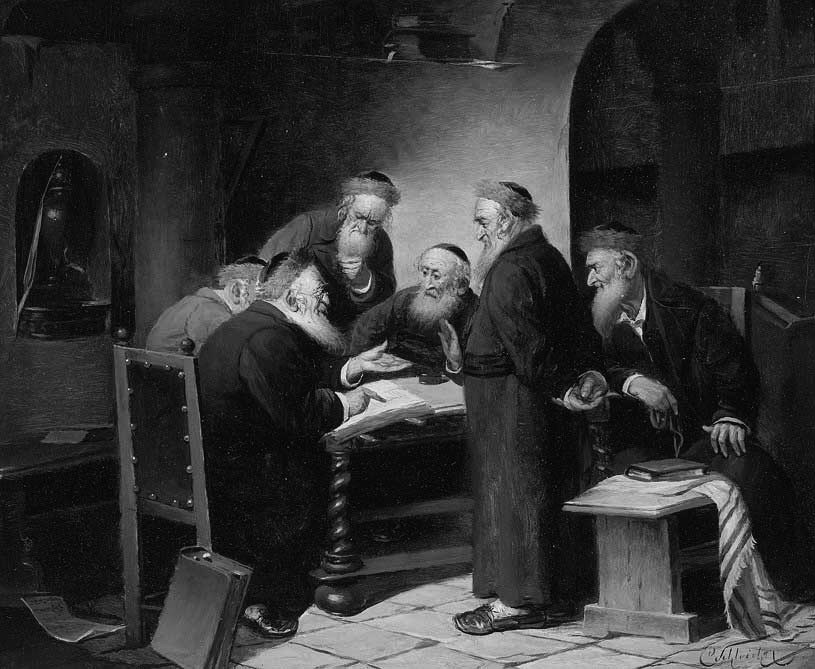
Because of these circumstances, Jews were constrained to cultivate the word as a sacred communion with the unknowable, the unseen, the unpossessable. It’s what has endowed Jewish thinking with a certain magic and has nourished those who either saw themselves as Jews or who were branded Jews. Hellenistic Jewish philosopher Philo Judaeus often invoked the “hieros logos” or sacred word, testimony to the Jewish tradition of valuing the word, of valuing intellectualism. Another key concept of Judaism is the embrace of open discourse and the perpetual questioning of ideas. This intellectual dynamism is rooted in the Jewish cultural and religious tradition, where interpretation and dialogue are not merely tolerated but exalted as sacred acts. In Jewish thought, disagreement is not a sign of discord but a vital expression of faith — an acknowledgment that divine wisdom transcends human understanding and thus must be approached from multiple perspectives. This culture of discourse also reflects the historical diversity of the Jewish people. My father’s godfather, journalist I.F. Stone, wrote in his article “Holy War” that “the periods of greatest Jewish creative accomplishment have been associated with pluralistic civilizations in their time of expansion and tolerance: in the Hellenistic period, in the Arab civilization of North Africa and Spain, and in Western Europe and America.” Spread across continents, Jewish communities absorbed, challenged, and reinterpreted surrounding philosophies. The resulting intellectual mosaic fostered a tradition in which debate became not only a mode of study but a mode of survival — a way to sustain identity and integrity in the face of exile, assimilation, and persecution.
The state of Israel is a progressively more grotesque betrayal at every level of this intellectual and ethical tradition. It’s a genocidal state built on ethnocentrism, on exclusion rather than empathy and on the worship of land and nation rather than the sanctity of the word. Zionism, in its political essence, inverts the very foundations of Jewish ethical and intellectual life. Where Jewish history cultivated solidarity with the oppressed, Zionism reconstituted Jewish identity around the marginalization and oppression of the Palestinian people. The transformation of an ancient, diasporic faith defined by questioning, openness, and ethical introspection into a nationalist project defined by borders and militarism represents not a continuity of Judaism but its negation. In this sense, Zionism is not the fulfillment of Jewish history but its tragic undoing — the substitution of ethical conscience for political sovereignty, for an ideology that exalts blood and soil over moral imagination, silences dialogue in favor of dogma, and extinguishes the very spirit of questioning, empathy, and universal justice that has animated Jewish thought for millennia. In his article, I.F Stone writes that Israel is fostering a form of “moral schizophrenia” within global Jewry. He displays how outside of Israel, the well-being of Jews relies on the support of secular, non-racial, and pluralistic societies. Yet within Israel, Jews are placed in the position of defending a society where racial exclusivity is idealized. Consequently, Jews are compelled to advocate elsewhere for their safety and survival while simultaneously upholding in Israel principles and practices they would otherwise oppose.
He also affirms that there is a good deal of “simplistic sophistry” in the Zionist argument that Jewish immigration to Israel was a return to the Jewish homeland, as the “whole earth would have to be reshuffled if claims 2,000 years old to irredenta were suddenly to be allowed.” Historian Shlomo Sand goes even further, finding in his book, The Invention of the Jewish People, that Zionist-influenced historians constructed a false narrative by portraying the Jewish people as having been forcibly exiled from Israel following the destruction of the Second Temple in 70 CE, wandering in the Diaspora until the Zionist movement ultimately restored them to their “rightful ancestral homeland” in 1948. Sand demonstrates what reputable historians of Judaism have long recognized: there is no evidence of a large-scale forced exile by the Roman Empire, and the global spread of Judaism occurred in part because it was, at various points in history, a proselytizing faith. According to him, Jews constitute a religious and cultural community without a distinct ethnic connection to ancient Israel — asserting that nearly all Jews today are descendants of converts, that the Jewish diaspora across the Mediterranean emerged from the spread of Judaism itself rather than from large-scale migrations — it was “Jewishness” that spread, not the Jews. He shows that for many centuries, most religious Jews viewed the Holy Land not as a physical location on earth but as a spiritual concept. It was only with the rise of nationalist movements in the 19th century that a new narrative emerged, portraying ancient Israel as a historical nation-state.
The catalyst of this rising nationalism came of course after the Second World War, as it took the murder of six million Jews to awaken sufficient nationalist zeal in Jewry and sufficient humanitarian compassion, as well as economic and political interest, in the West to bring a Jewish state to birth in Palestine. Some justify Israel’s increasingly ethnocentric character by pointing to the centuries of persecution endured by Jews in Europe and the Holocaust. Yet for those who have directly experienced the effects of racism and discrimination, such suffering cannot serve as an excuse to replicate oppression. Israel’s policies stand in stark contrast to the values that have historically defined Jewish thought: empathy for the marginalized, the pursuit of justice, and the embrace of ethical and intellectual openness. Rather than vindicating Jewish suffering, these actions represent a profound moral contradiction, illustrating how Zionism diverges from the core ethical and cultural principles of Judaism.
Written by Capitu Sarah Nossiter
References
I.F. Stone, “Holy War,” The New York Review of Books, 3 August 1967, https://www.nybooks.com/articles/1967/08/03/holy-war/
Shlomo Sand, The Invention of the Jewish People (Verso, 2009)

 Writer's Block Magazine
Leave a comment