
When I was in 8th grade, about 13 years young, my high school had a sex education project week that was supposed to inform and teach us everything there was to know about sex, pregnancy, intimacy and contraception. Besides having to pull a condom over a rubber dildo while being watched by my teacher as a part of our ‘examination’, we learned about the different methods of contraception, made a poster on which we collected all the names we might assign to our genitals and watched the movie Juno. Yet, the only thing my teachers (and the book) taught us about menstruation was that it happened. Preferably, once a month for girls starting puberty. That was it. It is a sign that you did not get pregnant. Period.
When I got my period for the first time, it was irregular, missing for several months at a time, heavy and painful. My mom had similar experiences, so I grew up thinking that it was normal. Only when I talked to friends about their menstruation did I realise that there are worlds of difference between my period and theirs. I had friends with zero pain and light bleeding that lasted three days maximum. Clearly, menstruation was more than just a monthly bleed for everyone. I lost my period for almost two years when I was battling with an eating disorder, but my gynaecologist told me not to worry: ‘As long as you do not want to become pregnant, you will be fine. Actually, you are not even fertile now, so this is kind of a natural contraceptive.’, she said and smiled. I was not told why I was missing my period, why a period is healthy or why missing or irregular periods pose a threat to your overall health and longevity. Did you know that your period is now acknowledged as a vital health sign besides your pulse or blood pressure? Having a period is essential for female health, vitality and longevity!
I was about 18 or 19 when I had a rough time at uni and a lot of physical health issues. Naturally, I began grasping for straws: listening to spiritual teachers, trying every relaxation technique out there, taking random supplements, seeing various doctors and so on. I stumbled upon a video of one of my favourite YouTubers back then, a girl sharing her life as a spiritual person, yoga teacher and nomad, travelling the world for her soul’s fulfilment. She posted a video in which she claimed to ‘live by her cycle’ for a month. At first, I was curious. What does that mean? Living by your cycle? I clicked and was amazed. This was it: my first step down a rabbit hole of education; education on menstruation not only concerned me, but also bothered and interested me. This knowledge was missing in my past conversations with friends, family members or teachers back in 8th grade. This was the first time I learned about the innate seasons of our cycles, what hormones are or do, why menstruation comes to be and how regulating your hormones can alleviate symptoms I had so long recognised as the ‘natural and normal’ female experience.
I began watching videos, reading essays and articles and, finally, buying a book that taught me more about my body in about 300 pages than I had learned in 19 years of life. I was astonished: There is a whole world, a microcosm of organs, hormones and functions that directly and immediately influence the macrocosm of my life. Back then, just to give you a little picture, I was dealing with heavy period cramps (which made walking impossible), long periods, mood swings, heatwaves, menstrual migraines, nausea before and during my periods, heavy bloating, brain fog, low energy, hair loss, anxiety, depressive thoughts before my periods and so on. And I thought that was normal! No one taught me how to regulate my period, let alone that was even something I could do. Reading the book In The Flo by Alisa Vitti was life-changing. I did have some minor issues with her narrative (i.e., she was frequently trying to sell her program and supplements, or she referenced studies that were not necessarily scientifically significant). Yet, I have learned so much that I apply in my life now, and that has granted me access to a simpler life.
Now, I will go into some detail and explain the basics of cycle syncing, hormonal phases and menstrual alignment. I personally had almost entirely good experiences (I will elaborate on the downsides of cycle syncing later). However, it is important to recognise that periods are as variable as our appearances. No two women have the same cycles, symptoms or, more crucially, solutions to hormonal imbalances. Additionally, you might be suffering from certain medical conditions which cannot be simply solved through cycle syncing. This ‘method’ is not a one-size-fits-all solution. Yet, I believe that you can experiment with yourself, you will find that some things work perfectly, and some do not at all. I can only advise you: take what you need and leave the rest, do your own research and check with your gynaecologist if your symptoms persist after you have adopted lifestyle changes. After all, cycle syncing for me is about alignment with my body’s natural cues, a kind of mind-womb connection that makes me more attentive to and nurturing of my own needs. Lastly, when I use ‘women’ in this article, I include anyone and everyone menstruating.
The Innate Rhythms: There were times in my life when I questioned my worth because of my performance. I had days of decreased energy, brain fog, procrastination or mood sensitivity. I did not understand why I worked and functioned so well some days and felt so utterly unlike myself on others. I began comparing myself not only to other women, but specifically to other men. My boyfriend did not experience the gigantic shifts in mood, energy, performance or identity I did throughout a month. In society, corporate jobs are built on an inflexible schedule: the classical 9-5 for five days a week. I was wondering, how did that come to be? Was I supposed to have a balanced and continuous level of performance or energy? Only when I started learning about the menstrual cycle did I also discover the presence of another, all-encompassing, life-dictating cycle: the circadian rhythm.
The circadian rhythm is the 24-hour cycle of hormones every human goes through every day. Hormones are chemical messengers which activate or deactivate specific functions in our brain and body. This waking-and-sleeping rhythm is dominated by hormones like cortisol and melatonin, whose build-up or breakdown defines our wakefulness or sleepiness. After waking and especially when viewing sunlight early in the morning, the body releases cortisol, which awakens itself and the nervous system. But the longer we are awake, the more melatonin builds up, eventually making us tired. Thereby, humans function on an (almost) perfect 24-hour clock. However, women with menstrual cycles have another vital cycle that defines their life and distinguishes the stable energy levels of men from their variable ones: the infradian rhythm.
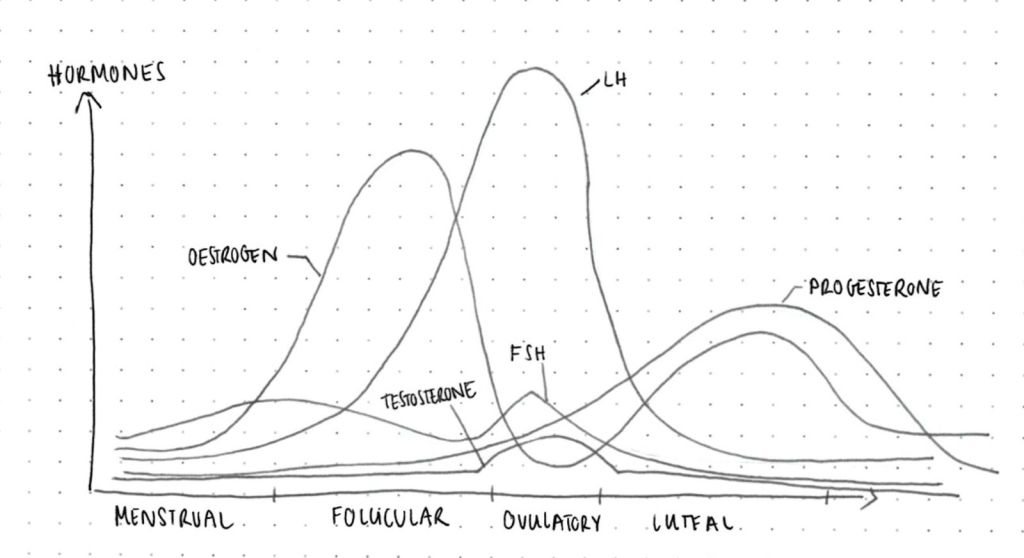
The infradian rhythm, or menstrual cycle, describes the (nearly) 28-day hormonal cycle that defines the female body, mind and (most of her) life. Hormones like oestrogen, progesterone, testosterone, follicle-stimulating hormone (FSH), luteinising hormone (LH), insulin, cortisol and many more shift periodically over more or less four weeks. These hormones are responsible for a variety of functions within the body and mind; however, they collectively influence the life of women every month. The fact that I experienced the world differently was not just based on assumption or imagination, but there was a biological reason for my symptoms, discomfort and differences. That was the solution I did not know existed. Every month, every 23 to 35 days to be exact, your hormones shift rhythmically to prepare for potential fertilisation. If that does not happen, the body releases its carefully prepared ‘nest’ for the reproductive cells of the male and sheds the uterine lining, which causes the bleeding, until we try again next month.
Every woman endures an average of 450 periods throughout her lifetime. It would be a shame to spend these in pain or unconsciousness, unaware of the inner seasonality that can be tracked, understood and embraced. I will explain the basics of the four seasons of the menstrual cycle, as I have come to know them. The follicular, ovulatory, luteal and menstrual phases work conjointly to prepare for fertilisation again and again and again. Aligning with this innate seasonality, you not only live more freely, awarely and compassionately, but you begin to unlock the power of each phase to live more at ease. Instead of being limited by your cycle, you can embrace the seasonality of yourself, tapping into each season’s innate function and aligning these with your personal dreams, goals and tasks. Here is an overview of each phase, its function and the lifestyle changes that support your body in its full expression and accomplishment of each hormonal period.
The Menstrual Phase – Winter:
The menstrual phase marks the onset of your new cycle and is described as the internal winter. Lasting everywhere from 3-7 days, your hormones are all at their lowest levels, and your body is shedding the uterine lining in the form of period. Usual symptoms include painful cramps, caused by the release of prostaglandin, which is a hormone-like substance that causes the release of your lining by contracting the pelvic muscles. Due to the absence of hormones or the hormonal decline happening before that phase, women might experience bloating, headaches or menstrual migraines, mood swings or emotional sensitivity, skin sensitivity or acne, breast tenderness, lack of energy and excessive need for rest. Hormonally, this is the time for rest, release and hibernation. Naturally, when bleeding, we have lower energy, get less done, have lower motivation and might deal with difficult symptoms which make movement or work utterly impossible. Here are some tips and lifestyle changes that align with this phase and help you to meet yourself with compassion.
The internal winter is seen as a time to turn inwards, take care of yourself and your womb, and reflect on the past month. Some people call this the season of your ‘wise woman’, clarity or intuition. You can journal and reflect on what you want to release, what no longer serves you and how you want to take care of yourself. You will appreciate the benefits if you can give yourself extra time to unwind, rest and do absolutely nothing. You want to nourish your body sufficiently, as it is releasing and losing essential minerals and nutrients. You want to prioritise healthy fats, iron, magnesium and protein to support your shedding and help alleviate period symptoms. Generally, you want to avoid caffeine, sugar, fatty, salty processed foods, which your body will be craving as your caloric needs are higher due to your body’s work of shedding the uterine lining. Instead, focus on cooked meals like soups and stews or curries, extra hydration, high fibre and antioxidants, buckwheat or wild rice, dark greens, beets, kale, mushrooms, blackberries, blueberries, beans, lentils, tofu, almonds, nori, miso, foods high in sodium and dark chocolate. Teas with ginger, fennel or raspberry leaves help alleviate cramps and heat the body internally, as it is usually at its lowest temperature during the entire cycle. Depending on your energy levels, you can engage in light-intensity movement such as walking, yin yoga, stretching or breath-work. I personally avoid any high-intensity movement and stop working out altogether for a few days when my cramps are too painful. Then, extra napping, sleeping, heat pads and hot baths help me to recharge and rest appropriately. The focus is on resting, nourishing and recharging during this winter. Your body has accomplished so much; it is time for you to acknowledge that and slow down, which will, in turn, help you alleviate symptoms that come from neglecting your internal cues and needs for rest.
The Follicular Phase – Spring:
The follicular phase marks the onset of a new season, emerging from hibernation of the winter, you embark on a new journey, lasting 7-10 days. The internal spring features the slow return, rise and peak of your hormones, particularly oestrogen and later FSH. While some might still feel the ripples of the menstrual phase, they slowly fade, and your energy begins to rise again with the increase in oestrogen. This hormone is responsible for many functions, here more specifically, leading up to your ovulation. During your follicular phase, oestrogen rises and reaches a peak while an egg is maturing in your ovaries with the help of FSH. Once your oestrogen level reaches its peak, the LH sets in to trigger the release of the mature egg into the fallopian tubes and with that, your ovulation. Again, while some may still feel symptoms of their period, they will begin to decrease, and you will find your energy, mood, motivation and wish to socialise rising. Here are a few adjustments that help you align and feel your best in this phase.
This bloom of sorts also relates to a creative bloom, which will cause you to dream big, begin brainstorming new projects, get into the creative flow, and open yourself up to the novel. You might want to reflect on your intentions for this coming cycle, visualise and plan your life, projects and passions, plant seeds or experiment. You want to consume probiotic or fermented, low-sugar foods to prevent an oestrogen buildup in the gut lining (which can relate to symptoms later in your period), eat lots of greens, lean proteins, and stay with sautéing or steaming foods, slowly incorporating raw foods the closer you get to ovulation. Prioritise vitamin C from citrus fruits and healthy fats, and consume more carbs as your body is better equipped to digest them now. Some foods suggested are oat, wheat, rye or barley, artichoke, broccoli, carrots, lettuce, peas, parsley, zucchini, avocados, pomegranate, plum, green lentils, cashews, nut butters, vinegars and pickled foods. You can slowly incorporate higher-intensity movements and move towards HIIT, fun cardio, or more intense strength training. Be creative, find new solutions to complex tasks and begin to socialise again. Generally, this is the phase for preparation, new beginnings, novelty and creation, the embodiment of an internal spring.
The Ovulatory Phase – Summer:
Now, this either is or will be your favourite season of all. The ovulatory phase marks the onset of your internal summer, lasting 2-4 days, and comes with a variety of hormonal peaks and internal changes. This phase is universally known as your fertility window. FSH, LH and testosterone have their peak in this short but sweet phase. FSH and the peak of oestrogen right before the ovulation trigger LH to release the mature egg, making it available for possible fertilisation. The peak in testosterone increases the sexual drive in this phase, which is a natural and rudimentary function: your body increases your libido to increase the chance of fertilisation during your fertility window. However, please bear in mind that while this is your most ‘fertile’ time of the month, you can also get pregnant during any other time of your cycle. Usually, sperm can survive up to five days in the reproductive system. But women have gotten pregnant even during their menstruation. There is no guarantee that your fertility window is limited to your ovulatory phase!
During this phase, you are at the peak of your energy, mood, productivity, motivation and socialising ability. Some people might feel like a social butterfly, their most confident selves and ‘best looking’ (which is partially due to perceptive changes and/or hormonal influences on their skin, digestion or appearance). However, if your hormones are generally imbalanced, your internal summer will not feel as cheery as you might want it to be and will miss out on this phase’s benefits. Your basal temperature is the highest in this phase, and your cervical discharge might increase during peak ovulation. Some women also experience the ‘Mittelschmerz’, an ovulatory pain in one side of their abdomen, caused by the release of the mature egg. Here are some adjustments you might consider.
The energy you embody is radiant, impulsive, daring and competitive. The extra energy and confidence allow hard conversations, meetings, social connections and your best performance in the gym or workspace. You want to focus on magnesium, fibre-rich, whole foods, raw veggies and cooling or light foods like salads to help you regulate your temperature and boost your nutritional needs. Prioritise quinoa, amaranth or corn, asparagus, brussels sprouts, red peppers, eggplant, spinach, tomatoes, spring onions or leek, berries, apricots, coconut, red lentils, almonds, pecan nuts, pistachios, turmeric or chocolate. In this season, your body can digest sugar and caffeine more efficiently than in other phases. Movements are high-intensity workouts, sprints, cardio or weight training, as your energy is at its peak. Generally, this is the phase to open up, collaborate, invest in your passions and shine with confidence as your hormones give you all the backup you need.
The Luteal Phase – Autumn:
This is the last phase of your cycle, lasting anywhere from 10-14 days before the onset of a new cycle. The luteal phase, or inner autumn, is the longest of all phases. At the beginning and mid-luteal stages, oestrogen increases slightly and progesterone peaks. This rise causes the thickening and maintenance of the uterine lining in which a fertilised egg might find a place to grow and develop. Progesterone influences, among other functions, sleep, mood, relaxation and immune function. While the beginning of the luteal phase is still impacted by the ovulatory phase, you slowly progress into a hormonal descent, or a more radical fall. This impacts your body significantly, causing many symptoms summarised as pre-menstrual symptoms (PMS), which are exacerbated by hormonal imbalances. These are usually breast tenderness or swelling, mood swings or sensitivity, digestive issues or bloating, skin disturbances, lack of energy or focus, brain fog, increased water retention, intense cravings (due to a heightened caloric need), higher insulin resistance (due to the rise of progesterone which influences your appetite and satiability), headaches, migraines or nausea and a decreased immune system response (due to the increased progesterone and preparation for a possible pregnancy). In general, the first half of this cycle differs from the second half, requiring different habits and needs for your body.
This is the phase for completion and sensitivity. The first half allows for the autumnal harvest of your labour: detail-oriented finishing of the last tasks, finalising projects and meeting with people, while the latter half calls for you to prepare for the hibernation of winter and tuning into yourself. You want to consume more calories, slow-digesting, complex carbs and magnesium as your caloric needs increase with the thickening of the uterine lining and the preparation for its shedding. Focus on baking, sautéing or roasting high fibre foods, brown rice or millet, cabbage, cucumber, cauliflower, celery, collard, garlic, ginger, onions, pumpkin, potatoes, sweet potatoes, apples, dates, peaches, pears, bananas, pineapples or mangoes, chickpeas, soybeans, walnuts and peppermint tea (which aides digestion). You want nourishing, whole and warming meals as your basal temperature begins to drop and you crave something salty or sweet. Try not to indulge in unhealthy, highly processed foods, as they will spike your insulin and cortisol and negatively impact your PMS symptoms and period. During the first half of your luteal phase, you can focus on slower-movement, less-intense strength training or low-impact cardio like hot yoga or pilates. The latter half of your phase calls for less intense movements like yoga, pilates or stretching. You can focus on finishing up organisational or deep work before you begin tuning inwards and caring for yourself in solitude. Plan more rest days, naps, increase your hours of sleep and acts of self-care towards the end of your inner autumn. This is a phase of work, completion and clarity, before you drop into your inner winter. Enjoy the fruits of your labour and slow down the pace.
Health Baseline and Other Key Factors:
While these are the four seasons of your cycle, it is integral to establish a healthy foundation for yourself before you begin adding or experimenting with the cycle syncing. In general, you should get sufficient sleep and mindful rest, enough regular exercise, eat balanced, healthy meals, expose yourself to sunlight, socialise and reduce your stress. Only when you achieve a healthy baseline and still experience hormonal imbalances or symptoms during your cycle, can you think about incorporating some cycle syncing techniques. Here are also some other key factors influencing your cyclic health, which you might have never considered.
Almost every tenth menstruating woman suffers from premenstrual dysphoric disorder (PMDD). This disorder is characterised by severe dips, changes and shifts in mood and behaviour around your period, which include depressive or anxious symptoms to suicidal thoughts. Your mental health has a great impact on your cycle and hormonal health, as it adds a stressor to your life and influences your behaviour. But you should consult a gynaecologist or psychologist/psychiatrist if you feel like you have shifts in mood and perception around your period that exceed the average sensitivity. Additionally, the cleaning products, fragrances, drug store makeup or supplements, and microplastics you use or consume can impact your hormonal health. Harmful chemicals enter your system and interfere with your hormone production or neural networks. Similarly, eating non-organic foods sprayed or enhanced with pesticides and antibiotics affect your hormonal health and production drastically. Lastly, stress, especially chronic stress, interferes with your health and longevity directly. It is a common cause of many life-threatening diseases and hormonal imbalances, as extreme cortisol levels diminish immune functions, impacting mood, energy and motivation levels, a healthy production of hormones and many more systems in your body. You want to minimise (chronic) stress and identify stressors that are unnecessary. Maybe incorporate meditation or relaxation techniques into your daily life, exercise regularly and take care of your mental health just as you take care of your physical health.
These are all factors which influence your cycle negatively. But what are some things we can add to support our female hormone health? The essential vitamins for women’s hormonal balance are high amounts of vitamin Bs, magnesium, omega-3, vitamin D3, probiotics (preferably from fermented foods or drinks) and antioxidants like zinc or selenium. I also consume Maca powder, which I only had good experiences with, personally. Maca is a Peruvian root vegetable that can be consumed in powdered or capsule form, which I have found to aid my hormonal balance. Additionally, the gut-brain axis is integral for many functions of the body, like mood regulation, immune response, and cognitive functions. Therefore, your gut health directly impacts your hormonal health, and a healthy gut supports balanced hormone production. Have you ever heard of Seed cycling? By consuming different seeds throughout the month, in concordance with your cycle, you can support your hormone balance by providing essential nutrients during the right phases. When consuming 1-2 tablespoons of pumpkin and flax seeds per day during your menstrual, follicular and ovulatory phase, you provide your body with essential magnesium and lignans, which support your oestrogen and mineral balance. Consuming 1-2 tablespoons of sunflower and sesame seeds during your luteal phase provides you with healthy fats, zinc, selenium, vitamin E and lignans, balancing and nourishing your system.
Reflections: Now, what can you take away from all of this? Firstly, my experience. Once I dove into the world of cycle syncing, I felt like I understood myself better and could offer the self-compassion I could not give myself before. I began following food and exercise protocols, taking essential vitamins, scheduling my life and work mainly around my cycle, decreased my sugar and caffeine consumption and began seed cycling. Never could I have imagined menstrual phases so utterly symptom-free! The symptoms I did have were so mild that they became manageable, and I felt like I unlocked the door to a vital connection between myself and nature. However, life got in the way, I moved to another country, began a new study programme, became busy, and so the discipline and exactness of my measures decreased. I became stressed again, and that is the major contributor to my hormone imbalance.
Secondly, every woman is different, and simply following a protocol will not necessarily lead to better outcomes. But I believe that the knowledge and understanding of our cycles is necessary for our health and well-being. I can only encourage you to do your own research or begin by implementing one habit or change, depending on your cycle. Begin by tracking your period, moods or symptoms with an app or manually. I bet you will begin to see patterns and rhythmical shifts, whatever they may look like for you.
Lastly, I want to address a negative consequence of cycle syncing: the pressure. The pressure to perfectly adhere to the cycle and follow behaviours or eating rules some random woman put on the internet created an immense internal burden for me, and many other women I know. Do not work out on your period, only eat salads during ovulation or finish your projects during the luteal phase, does not match the chaos life sometimes offers. Rather, these pressures of perfection will probably cause stress, which then negatively impacts your cycle. That means you can do everything right and still not feel better because you are not approaching it with ease, but force. No one can adhere to cycle syncing perfectly, and you should not try to achieve that.
However, I believe that the awareness of your innate seasons gives you an opportunity to tune into a seasonality you might not have noticed before. Living in companionship and admiration with this seasonality grants you the gift of compassion and understanding, which makes your life easier and may even alleviate some of the symptoms we were told to tolerate quietly. Living in tune with seasonality, as I have explored here, may improve the quality of your life if you give it a shot. I am glad to have educated myself on the cyclic nature of my menstruation, and I am glad to educate many more women on this to prove that there is a softer way of living – a way that only requires you to listen to your innate seasonality and tend to your needs.
Written by Pia Jung
 Writer's Block Magazine
Leave a comment