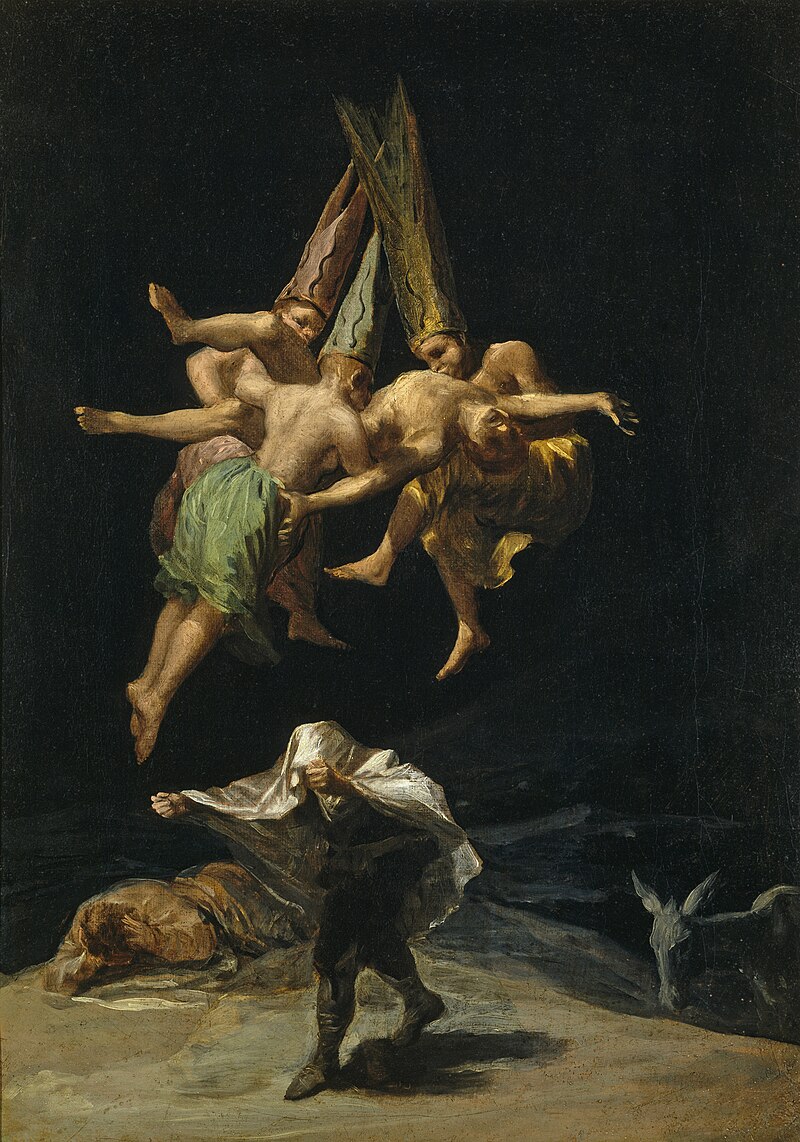
Vuelo de Brujas, by Francisco Goya
The Parable of the Wise and Foolish Builders
The deeper meaning of a text, if not deep enough, swallows the whole text like quicksand, leaving only a brief moment of understanding and no moment of reflection. The events, language, and implications – the surface of narrative – should be built on bedrock, worthy on their own, without that meaning. The ‘true meaning’ of a text should be impenetrable beneath it.
When the deeper meaning of a text is found after little digging, the actual text becomes an insignificant façade housing the only essential part of the text, the meaning.
The meaning of such a text becomes meaningless, as it is impersonal and unimpactful. Impersonal because everyone finds the same, readily apparent meaning. No need to think about it yourself. Unimpactful because the reader does not need to work for the meaning, it is just given. The ease of the battle negates the joy of victory.
This is why I believe all narrative works that act as clear-cut allegories are spiritless. Literature is made parable, a simple story teaching a simple lesson. Wise writers choose sounder pedestals for their texts than lessons for children.
The downfall of allegorical writing can be summarized by its three failures. Firstly, an immediately found meaning murders the multi-interpretability of a story, possibly its most foundational strength. I know Jerzy Kosiński’s Being There is only about the idiocy of politics, about how singular sound-bites always beat well-argued, uncomfortable truths in a democracy, something Plato put more cleverly, succinctly, and less homophobically in his Allegory of the Doctor and the Pastry Chef, more than two-thousand years earlier. Being There’s meaning can never be anything more to me, so it can never mean anything more to me. Secondly, a clear-cut meaning robs the narrative of its realness. While literature is not real, it does feel real. Unless it doesn’t. If all characters are purely tools in service of a larger lesson taught, why should we care for these characters? If the struggles of these people are merely metaphors for the ‘true meaning’ of a text, why should one be interested in its outcome? If the titular old man in The Old Man and the Sea is a stand-in for aging strength and human persistence, not a real character, why should I care if he catches the fish, if his doing so is a metaphor, rather than a true victory? Lastly, these parables unavoidably become steeped in a sort of profound meekness. This is difficult to argue, as it really is just a feeling. Yet, I know it to be true. Parables, biblical or literary, feel soft, like a loose-fingered handshake, like a damp towel; it all exudes deeply uncomfortable mushiness.
Parables are stories built on sand and they sink into the hole where a narrative’s real power should be. Except horror movies. All of my favorite horror movies are clear-cut allegorical parables. And I adore them. The evil killing monkey in Oz Perkins’ 2025 horror-comedy The Monkey is an analogy for generational trauma, the story is a transparent metaphor for learning to live with it. Wonderful movie. The trailing figures stalking the main characters in Robert Mitchell’s 2014 movie It Follows are obviously symbolic of STD’s. Phenomenal film. The porcelain hand you shake to be possessed by a demon in the Philippou brothers’ 2022 film Talk to Me is a straightforward stand-in for teen drug use and TikTok trends. It is the single greatest horror movie I have ever seen. Why? How? What?
The Parable of the Good Samaritan
The softness parabolic stories radiate is not present in horror films, regardless of their allegorical nature. There is too much running, sprinting, robbing, panting, beating, screaming, abandoning, wailing, howling, and cutting and tearing and gnawing. Filmsets where the abundance of fake blood makes the stage-planks rot cannot produce a movie akin to a moist towel. That’s the first problem taken care of.
Secondly, horror movies do not lose realness because they are metaphorical. They claw their way back to reality through the visceral nature of their action, and the audience’s proximity to this action. Like the Good Samaritan finding a man robbed, beaten, and abandoned by the side of the road and showing compassion, any audience member with a beating heart cannot help but hope for the survival of a main character if their struggle is severe. And in horror movies the struggle is always severe. The fear and anxiety brought on by a good horror movie blots out the sneaking suspicion that all characters are tools in some simple metaphor. Yes, maybe It Follow’s main character Jay is a narrative device in a downright silly parable warning teens about unprotected sex, but, shit, that thing’s coming for her, and it’s going to tear her to bits, and, oh Jesus, run Jay!
The Parable of the Mustard Seed
The final issue of parabolic writing that horror is left to contend with is the lack of interpretations possible in such a one-to-one, story-to-meaning narrative. Yet horror survives this too. Because both genres, the parable and the horror film, are essentially mirrored processes of negation.
Parables are reductive by nature. They are only about a single thing, a single meaning, and they erase everything else unimportant to that one meaning: boldness, realness, and multi-interpretability. A single small sliver is left, a single little mustard seed. And it falls on barren ground. The parable has erased all that makes literature great. Through its tunnel-vision-focus on the conveyance of a singular lesson, it has murdered art.
Horror movies are equally reductive by nature. They are only about a single emotion, fear, and they kills everything else unimportant to that one emotion: subtlety, stomachability, and multi-interpretability. Horror movies are one of two genres that are wholly centered on a single emotion, comedy being the second, with its singular focus on humor. However, whereas humor can come from anywhere, a remark, look, color, sound, smell; fear has to come from a single definable danger. The movie monster. The killer. The Monkey. The hand’s demons. The ‘it’ that follows. Meaning can come from anything in a movie. Humor can come from anywhere. Fear can only come from a threat. And everything not in service to this one thing, this one emotion, this one threat, a good horror movie cuts out. Exposition. World-building. Character development. Interpretability. A single small sliver is left, a little mustard seed. But it falls on fertile ground. Everything horror cuts it can lose without losing any of what make it great. Through its tunnel-vision-focus on the conveyance of a single emotion, it has murdered art correctly.
Horror is a unique thing in this sense. A genre where the base emotion it produces and its inherent structure overpower weaknesses that have hampered some of the greatest writers in our world’s history. Horror stories might be swallowed by the quicksand of their monomania, but it is under that molten surface that it grips you most ferociously, there where you cannot move or scream or do anything but watch.
Written by Arthur Mulder
 Writer's Block Magazine
Leave a comment