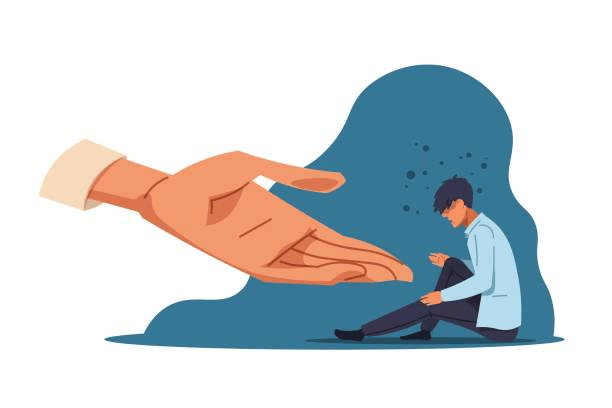
Last week, I was talking to my boyfriend on the phone and he told me about this friend of his, who admitted that she often had intrusive thoughts. This comment, made in the most laid back environment possible, made an impact, because what she meant was not what the media has been calling an intrusive thought recently. She did not mean that she thinks about insulting her boss, for instance; because that would be more impulsive than intrusive. It is a politically incorrect idea, but not a socially or morally “wrong” one. She meant the actual psychological interpretation of the term, those ideas that crawl into our brains and physically upset us. Those that make us question whether we can even fit into society, because no one else seems to be experiencing them. And, when you think you may be expelled from a society (a group of friends, a classroom, a job environment), that fear increases. The idea that something is wrong with you, with your train of thought. Some carriages are lost; its path it’s not as it should be. Or how everyone else portrays the correct way for it.
Generally, we want to be special, individual, recognised. We want to be known by our first and last name, maybe not on a worldwide scale, but everyone can relate to that strangely unpleasant feeling when they tell you “you remind me of…”. You are you, uniquely irreplaceable. However, emotionally (deep within us), we just want to be understood. We want to have our feelings validated. We want someone to look straight into our eyes and tell us that we are not crazy, not broken, not weird. We want a hug that says “I know you” more than words can. We want to relate to the deep secrets of the universe by having a friend that claims “I would have done the same thing”. Psychologists know better than anyone how desperate this wish can be, how relieved a person can be when someone reduces their fear of not being okay. And it is, in fact, natural to long for this. It is normal to not feel what seems correct at all times, and it is also normal to seek acceptance. Of course, this does not mean that all attitudes or impulses should be socially acceptable: I believe the limits reside precisely in other people’s dignity. When these troublesome thoughts turn into actions that negatively affect others (violence, sexual abuse…), a line needs to be drawn. Unfortunately, many of those thoughts can get out of hand in minds that do not have the tools to regulate them. But we should not draw the wrong conclusion: having specific thoughts does not make you a bad person. Not working on them, or acting upon them, is what might. We remain simply people, and the human brain is an extremely complex matter.
Therefore, there is something beautiful about how we seek comfort in others’ experiences. How a distant friend can soothe your soul more than a therapist, just by saying “what you’re talking about is not so strange”. How soothing can words possibly be? Better said, it’s not only about the words, but the bridges that are built between minds by using these words. It’s a recognition, a spark, the peak of identification, the final prize that your inner self was looking for. This is one of our greatest triumphs as a society. We remain connected through experiences that eventually help others feel more alive, feel like they belong. Not only when explaining younger students how your high school teachers were, not only when helping a sibling with something you already lived. This sharing is somehow bigger than that, and also smaller, because it’s just as specific as it can be: everyone can have intrusive thoughts, but not all thoughts are the same. And I’m not focusing on any particular thought, state of mind or emotion, not to make this abstract; but because I want to convey the pure impression of this “human relieving” that can happen in any situation. This can be seen in relationship advice, in conversations about work decisions, study, parenthood; in intrusive thoughts about unpleasant topics. In listening to ideas about life and death, politics, opinions on the world. Opening up about what goes on in one’s mind can also be key in approaching mental health issues such as suicide and eating disorders. Despite each experience being distinct, sometimes that “I see you, I understand you” can make a huge difference.
We want to have our particular situation distinguished from the rest, but understood by everyone, by someone, by anyone who can truly comprehend us. Even when what we think may not be morally correct, we hope that our listener’s moral will adapt, or disappear. We are human above all, and perceiving acceptance when sharing what your heart and mind are going through, is one of the most relieving experiences ever. In those cases, we do not necessarily wish to be recognised, or to be distinguished from everybody else. Quite the opposite: we aim to be accepted back. We aim for society to open back its doors, as if it was a welcoming neighbour. So, in case you might be doubting yourself: you are okay, you are seen.
Written by Raquel Rodríguez Mulero
 Writer's Block Magazine
Leave a comment