“You do not have to be good. You do not have to walk on your knees for a hundred miles through the desert, repenting.”
Wilde Geese, Mary Oliver
Rage (n.) is defined in the Cambridge English dictionary as “extreme or violent anger”. Similarly, Merriam-Webster phrases it as a “violent or uncontrolled anger”. There are thus two ingredients that make up rage: violence and anger. And I think we can all agree that’s pretty accurate. Rage is often depicted in the media as intrinsically tied with violence, but we don’t have to resort to fictional worlds to understand this connection. In The Netherlands, 80% of women murdered between 2018 and 2022 were killed by a former partner or a family member. Most of them probably endured ongoing domestic violence, because as research shows, a partner who has strangled you in the context of intimate partner abuse, is more likely to kill you. If we visualise the word rage, if we think about this term as a stand-alone, it is very likely that the first image that comes to mind is a red-faced guy smashing a wall rather than a woman punching someone in the face.
Rage is a peculiar, policed kind of emotion. It is not to be embodied by everyone in the same ways. At the Miss America protest during the second wave of feminism, women were captured tossing their bras in the Freedom Trash Can and, as the myth goes, setting them alight. Except that actually, they never did. Instead, the term “bra-burning feminist” was coined to describe angry, men-hating women, and to discredit the severity and validity of women’s intense dissatisfaction with their (lack of) jobs, their lives, their bodies. After that, feminists were labelled as radical and their political agenda was trivialised, which is quite ironic to think about when one considers that 51 years later, Donald Trump would instigate the attack on the United States Capitol in which 4 people would lose their lives, and he would, despite it all, proceed to be re-elected in the 2024 presidential election.
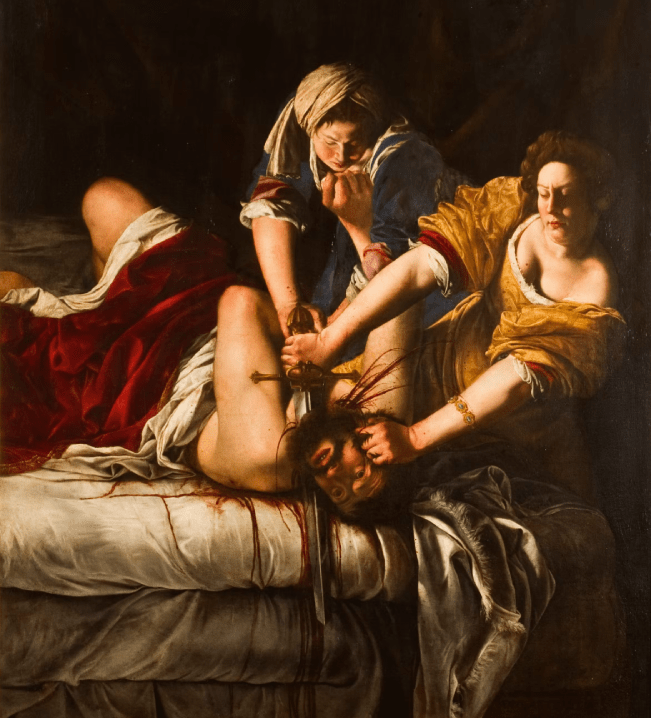
Women who express their anger, be that in a violent or non-violent way, bring about extreme discomfort in others. Try to visualise a woman punching a wall with her fist or getting into a physical altercation and see how off it feels. It doesn’t necessarily feel off because violence is morally wrong in most if not all situations; it feels off because we’re not used to witnessing such uncontrolled displays of emotion in women. The representation and interpretation of such was often left in the hands of men like Sigmund Freud, who were quick to label “misplaced” emotional reactions as hysteria and would discard them as inappropriate, instead of seeing them as they are: an important piece of information on someone’s inner world. We innocently thought to have been freed from this curse during Tumblr’s 2012-2014 peak with the birth of sad girl core, and we again settled for an easily digestible representation of emotion: a thin, white, tall girl who smokes cigarettes; functions on coffee only; looks out the window with an air of elegant solitude. Tears stream gently down her face, her makeup untouched. The epitome of delicate and broken beauty, and we ate it all up.
Even female rage is depicted in the media in very specific ways. In Girl, Interrupted, Lisa’s (Angelina Jolie) major anger outburst waters down to her crying on a hospital bed, as her anger and blatant disregard of others is just another symptom of her antisocial personality disorder diagnosis and she slowly starts to realise that it eats away at her as much as at the people around her. Florence Pugh’s cathartic performance in Don’t Worry, Darling is the portrait of an angry woman who has been lied to and manipulated by her husband in the worst ways imaginable, and as she vehemently screams “it was my life”, her eyes start to water and tears roll down her face 30 seconds later. In Hidden Figures, Katherine’s (Taraji P. Henson) brilliant monologue on horrid discrimination against Black people opens with her voice breaking and her eyes welling up as she starts screaming. When she finishes her sentence, she takes a deep breath and says: “So, excuse me if I have to go to the restroom a few times a day”. The pattern that I’m trying to point out here is displays of anger that are followed by tears, a deep breath and a profound sadness. These are mannerisms and feelings that bring these characters back to a “dignified” female space, because as Kimberly Jon Bautista says in her essayBeneath the Cool Girl Exterior: Why Female Rage Films Are All the Rage, “women have just been conditioned to respond to suffering with sorrow and misery” and to “hold our pain quietly”. We are expected to cool down, to cry and repent after being angry to show that we haven’t lost it–whatever it might be.
Of course rage and sadness are two intrinsically connected feelings. We’ve all heard about the five stages of grief and how they’re both equally important to process things that have affected or damaged us in some way, but I feel like we as a culture have been ignoring the fact that according to these stages, bargaining comes after anger. That is not a coincidence. Anger activates us, either positively or negatively depending on what course of action we choose to take, but it activates us nonetheless. It moves and pushes things, it forces us into action, it sets in motion what had been previously doomed static. Anger is an important piece of information because it communicates that what is happening to us is unjust before it is too big or too late for us to tackle. If we’d facilitate an environment in which it feels safe and acceptable for women to express their anger instead of keeping it inside, we wouldn’t be feeling so much collective agony. We wouldn’t be developing depression, anxiety, eating disorders and other forms of self-harm in an attempt to escape the narrowing distress trapped inside.
You do not have to be good. You do not have to be delicate and beautiful in your sorrow, or be something to coddle over. Maybe if we had the courage to be a little “uglier” on the outside, a little bit more defiant, we would stop inflicting the most harmful kind of violence–that which we direct at ourselves.
 Writer's Block Magazine
Leave a comment