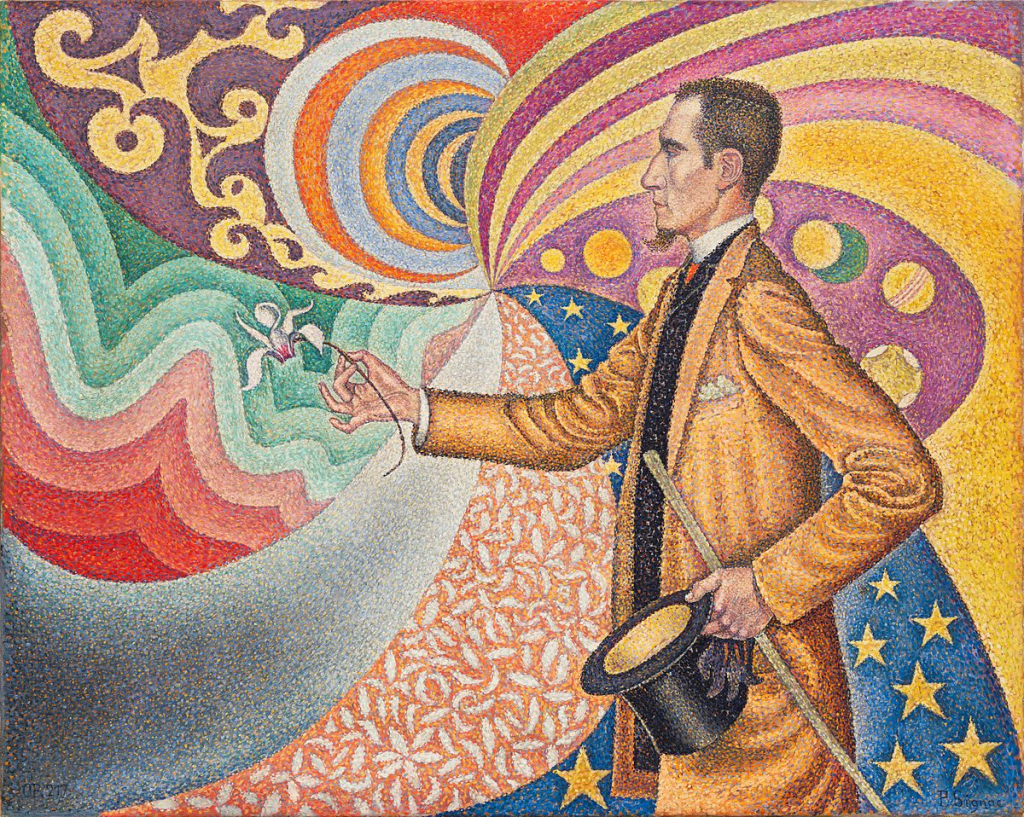
Paul Signac, Portrait of Félix Fénéon
Not to sound like a boomer, but nowadays, our entire lives are spent behind screens. I’m not saying it’s necessarily a bad thing! Technology has allowed us to achieve some pretty amazing feats, but it is no lie that most of us probably spend too much time on our phones and on our laptops. Everything is digital—news, photographs, conversations, and even money. There has to be some sort of a cultural impact of such rapid digitalization, and I’ve noticed that this impact has manifested itself in the form of regression: a return to physical possessions as opposed to online, cloud-based ones. People, especially The Youth, still spend way too much time on their phones, but there is a new wave of interest in what are now considered relics of the past: CDs, vinyl records, disposable cameras and the like. Perhaps it is a question of Aesthetic, which can encompass many things (remember when people would simply label something “aesthetic” and not specify what kind? What the hell was that?). Whatever the reason is, we’ve turned retro, and it’s awesome.
I started collecting CDs a couple of years ago, even though I have Spotify Premium and can access an unlimited number of albums for just 5 euros a month instead of paying 10 to 15 euros for each CD record. I’ve so far only been buying my favorites—The Black Keys’ Turn Blue and Jeff Buckley’s Grace, to name a couple—and having physical copies of the albums that have really spoken to me is something that I cherish greatly. The thing is, CDs make listening to an album a whole experience instead of, you know, just listening to music. Today’s music industry is ruled by popular, profitable singles, so CDs make us pay attention to things like coherence and composition. It’s the same with collecting vinyls, except they’re more expensive. I asked a friend of mine who likes them why she prefers them, and she explained:
“By buying a vinyl record, you get to appreciate not just the cover art but also the packaging, and it’s more tangible so it’s a less passive experience than just clicking a button on your phone or laptop and playing a song. It feels more personal because even if a record is mass produced, the specific one I bought is just mine as opposed to an online file that millions of people have access to at the same time.”
That’s the magic of music that you can physically hold; it makes it more special, more personal. In the age of social media where the only exclusive thing to you is personalized ads, it’s important to regain some sense of intimacy with a work of art.
Another thing that’s made a comeback is disposable cameras! My own walls are covered in photos I’ve taken over the last couple of years. I’ve made it a habit to buy a disposable camera (Kodak, not Fujifilm, has better quality in terms of saturation and resolution I’ve found) whenever I was taking a trip somewhere. All over my apartment are photos from cities I’ve been to, but what I’ve noticed is that barely any of them are of scenery despite them being taken in some of the most beautiful places in Europe. No, most of them are of my friends. Some are posed, some are candid, but all of them feel real because they are not on my phone. This is the appeal of disposables: since there is no chance to edit them, and since you can’t even see them until they are developed (probably months later because you kept forgetting to take them to the shop), they feel more authentic. Unlike taking a picture with a phone, you don’t worry much about lighting, or composition, or anything, really. You’re in the moment, the button goes click and the camera does all the work for you and you don’t have to worry about if it turned out well or not. Same goes for Polaroid pictures, which have been around for a bit longer than disposables, but something about that white border around half-blurry photos is absolutely *chef’s kiss*. What I also have on my walls is postcards. From museums and gift shops, I’ve taken to collecting some of my favorite artworks in the form of postcards and hanging them up. Do I need to buy these postcards when I could simply find a photo online of Paul Signac’s Portrait of Félix Fénéon (pictured in the header) and print it? Probably not, but the point is that I was in Paris at the Musée de l’Orangerie, saw the painting, liked it so much that I decided to buy a postcard of it at the gift shop. It’s less about the painting and more about the memory. That’s why all these disposables and Polaroids are preferable to many over pictures on a phone: when they’re physical, they’re proof that I was there, I experienced that.
Of course, as an English major, who would I be without my books? I do prefer physical books over ebooks precisely for the same reason people are turning to disposables. I like feeling the pages between my fingers, using receipts as bookmarks and dog-earing favorite passages (don’t judge me). I see the usefulness of ebooks or audiobooks, but again, I’d rather have bookshelves full of stories that have made me laugh, cry, and think, rather than a single app on my phone. I don’t think there has necessarily been “a return” to print books in terms of popularity; in fact I believe audiobooks are on the rise in that area. It’s more that print books have never been not popular: they still outsell ebooks. I’ve heard many a student say they prefer to study with paper books rather than PDFs, because having a physical copy gives you a sense of progress, and because reading comprehension for long texts is better on print. Stephen Fry once said, “books are no more threatened by Kindle than stairs by elevators”, and I think it still rings true.
Other relics, however, have not been revisited. Blockbuster stays dead, nobody really buys DVDs anymore because everything is on Netflix or Amazon Prime or Hulu or any of the billion other streaming platforms. That’s probably because there is not much of a difference between owning a DVD and watching that same movie online; the DVD doesn’t really change the way you experience the movie. Of course, it’s nice to have a physical copy of, say, your favorite movie, but you would still be watching it on the same screen in your living room so does it really matter if it was on Netflix or if it came from a disc? I’d argue not.
Now the question is, why this revival of certain items from the past? What concerns me when it comes to all our belongings existing online in the cloud somewhere is that it could all go away in the blink of an eye. A study sponsored by Microsoft entitled “Lost in Translation: Understanding the Possession of Digital Things in the Cloud” suggests that with the move to online spaces, the relationship between a person and their belongings have changed: “‘possess’ is not merely a noun nor a verb, but a complex set of actions that transform the relationship between a thing (virtual or physical) and a person”. The study goes on to argue that “material possessions are essential to the repertoire of identity”, and that “online digital things ‘break the rules’ of how we understand possession of material things”. Perhaps it’s a reaction against this breaking of rules that makes us want to revisit familiar physical objects. Or, perhaps we just think it looks cool. Either way, I do believe this is a temporary fascination until we fully submit to the online way as we all get chipped and uploaded into the cloud Black Mirror style. Until then, let’s enjoy our charming mementos while they last.

 Writer's Block Magazine
Leave a comment